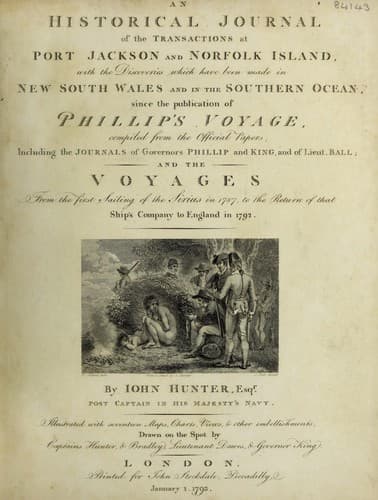
An Historical Journal of the Transactions at Port Jackson and Norfolk IslandHunter, John
History
An Historical Journal of the Transactions at Port Jackson and Norfolk Island
Hunter, John
New South Wales -- History -- Sources
I accompanied Governor Phillip to this place, which is named
Rose-Hill, on the 9th: we left Sydney-Cove at eight in the
morning, and arrived at Rose-Hill before noon. About two miles
below this settlement, the harbour becomes quite narrow, being
not more than ten or twelve yards across, and the banks are about
six feet high: here, the country has the appearance of a park. In
rowing up this branch, we saw a flock of about thirty kangaroos
or paderong, but they were only visible during their leaps, as
the very long grass hid them from our view. We landed about half
a mile from the settlement, and walked up to it.
This settlement is on an elevated ground, which joins to a
fine crescent, as regular as if formed by art; it is probable
that this crescent, and the regular slopes which surround the
settlement, have been formed by very heavy rains. The soil is
loam, sand, and clay: the trees are not so large here as lower
down the harbour, but the large roots lying on the ground render
it difficult to clear. A fine stream of fresh water runs into the
head of the harbour, which, in the winter, and when heavy rains
fall, sometimes rises seven or eight feet, and becomes a rapid
torrent. A redoubt is constructed here, in which are very good
barracks for officers and soldiers: there is likewise a
store-house.
On the opposite side of the brook, there is a farm-house,
where a servant of Governor Phillip's resides, who is charged
with the superintendence of the convicts and the cultivation of
the ground; to which charge he is very equal, and is of the
greatest service to the governor, as he has no other free person
whatever to overlook any piece of work carrying on by the
convicts. Near to this farm-house, there is a very good barn and
a granary. The convicts houses form a line at some distance, in
front of the barracks, with very good gardens before and behind
each house: indeed, the whole, joined to the pleasantness of the
situation, makes it a beautiful landscape.
In 1789, the quantity of ground sown with wheat here, and at
Sydney-Cove, was twenty-two acres; with barley, seventeen acres;
flax, Indian corn, and beans, three acres. The quantity of wheat
raised was two hundred bushels; of barley, sixty bushels; flax,
beans, and other seeds, ten bushels: the wheat is a fine full
grain. This year (1790) near one hundred acres will be cleared at
Rose-Hill, of which forty are to be sown with wheat.
After dinner, I accompanied the governor from Rose-Hill to
Prospect-Hill, which is about four miles distant: we walked
through a very pleasant tract of country, which, from the
distance the trees grew from each other, and the gentle hills and
dales, and rising slopes covered with grass, appeared like a vast
park. The soil from Rose-hill to Prospect-Hill is nearly alike,
being a loam and clay. It is remarkable, that although the
distance between these two places is only four miles, yet the
natives divide it into eight different districts.
Public-domain text, read in full here on John Shaqi.
Reviews
Reviews
No reviews yet
Be the first to share your thoughts on this work.
Elsewhere in the archive
Join the Discussion
Join the discussion
Sign in to leave a comment or review.
Sign InorCreate an account