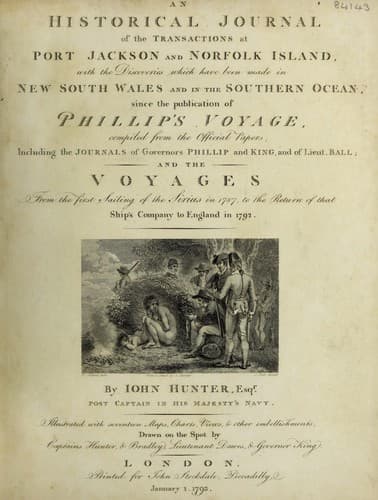
An Historical Journal of the Transactions at Port Jackson and Norfolk IslandHunter, John
History
An Historical Journal of the Transactions at Port Jackson and Norfolk Island
Hunter, John
New South Wales -- History -- Sources
No other answer could be got, than that the council were to be
requested to permit Lieutenant Ball to purchase whatever he
wanted, and to hire a vessel to carry what he might want to Port
Jackson: this being settled we took our leave. The Shebander drew
up a request, which Lieutenant Ball signed, and the next day it
was presented to the council, (at which the director-general
presided, on account of the general's indisposition) when every
thing was granted; but they refused to interfere in taking up a
vessel, or in purchasing provisions, saying, that those matters
were to be managed by Lieutenant Ball.
As every vessel here either belonged to the company, or were
too flimsy to go on such a voyage, it was for a short time
doubtful whether one could be procured: at length, the Shebander
hearing that a snow of 250 tons or upwards lay at a port called
-Samarre_, on the east side of Java, he offered her to
Lieutenant Ball; saying that he would purchase her and fit her
out completely, if Mr. Ball would contract with him to pay eighty
rix-dollars a ton for the voyage; the Shebander to take all
risques upon himself, with respect to the loss of the vessel. As
the necessity for a supply of provisions was very great, and as
there was no other vessel to be procured, Lieutenant Ball was
obliged to make the agreement, and the snow was sent for.
Provisions were easily purchased, and at a cheap rate: very
excellent beef and pork at six-pence per pound. Of flour, there
was little to be procured, as all the people here eat rice,
Europeans as well as natives.
Batavia has been so very well and so fully described in
Captain Cook's first voyage, that any attempt of mine to describe
this vast and splendid settlement may be deemed superfluous;
however, as these pages may probably fall into the hands of some
who have read no other account, I shall subjoin what few remarks
occurred to me during my stay there.
According to the best accounts I could obtain, the city and
its environs cover a space of eight square miles: it is situated
about half a mile from the sea-shore, and has communication with
it by a canal, which will admit vessels of eight feet draught of
water. The city stands on a flat, which extends forty leagues to
the foot of the nearest mountains. Two large rivers, which are
divided into a number of canals, run through all the principal
streets of the city, and on both sides of the different roads:
these canals are navigable for large boats; they are planted with
trees on each side, which are kept cut in the form of a fan.
The streets are all drawn at right angles, and are in general
wide, with very good pavements; along the sides of which a double
row of trees are planted, which greatly prevents the circulation
of air, and tends very much to increase the natural unhealthiness
of the place. Within the past four years, most of the canals
which contained putrid water have been filled up, and great
attention is now paid to removing dirt and other nuisances.
Public-domain text, read in full here on John Shaqi.
Reviews
Reviews
No reviews yet
Be the first to share your thoughts on this work.
Elsewhere in the archive
Join the Discussion
Join the discussion
Sign in to leave a comment or review.
Sign InorCreate an account