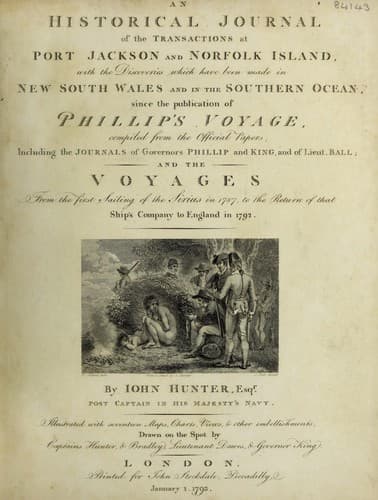
An Historical Journal of the Transactions at Port Jackson and Norfolk IslandHunter, John
History
An Historical Journal of the Transactions at Port Jackson and Norfolk Island
Hunter, John
New South Wales -- History -- Sources
All the houses are well built; indeed, some of them are
magnificent buildings, and are finished with elegant neatness;
which, added to the great cleanliness observed by the
inhabitants, renders them very agreeable retreats from the
intense heat which is constant here.
No European can do without a carriage, the paint of which, and
his other equipage, denote the rank of the owner; to whom the
necessary respect must be paid by people of an inferior rank; for
a noncompliance with this custom, a fine is levied by the Fiscal.
The town is but indifferently defended, as the fortifications are
irregular and extensive, and the walls (which are painted) are
very low: it is surrounded with a deep and wide canal, but the
best defence of this settlement is its extreme unhealthiness. The
citadel, or castle, stands on the right of the city: in it are
deposited a vast quantity of cannon and other munitions of war:
the governor-general, and the rest of the company's servants,
have apartments in it, and here the governor and council meet
twice a week, to transact public business.
The police of this city is strictly attended to, and is
calculated to preserve great order and regularity; but it is
attended with some mortifying and degrading circumstances, which
Europeans find great difficulty and repugnance in complying with;
however, the inhabitants and the company's servants must observe
its rules with a scrupulous attention, not only to avoid paying
the fines, but also to avoid the resentment of those who have it
entirely in their power to advance or retard their promotion.
The suburbs are inhabited by the Chinese and Portuguese: the
houses of the former are very numerous, but they are low and
dirty. The number of Chinese resident in and about Batavia in
1788, was 200,000: it is these people who are the support of this
important settlement; and if they were obliged to abandon it by
any impolitic measure, it would soon lose its splendor. The
Chinese carry on every trade and occupation; the better sort are
very rich, but they are subject to great exactions from the
company, or their servants. They are suffered to farm the duties
of exportation and importation, for which they pay the company
12,000 rix-dollars in silver money per month. All goods belonging
to the company are exempt from duties, but those of every other
person pay eight per cent.
About three quarters of a mile from the city is the Chinese
burying-ground, consisting of fifteen or twenty acres: for the
annual rent of this ground they pay 10,000 rix-dollars, and, at
the end of every ten years, they repurchase it for a very great
sum, which in general is regulated by the governor and council. A
person of consequence assured me, that the Chinese pay a tax of
20,000 rix-dollars a year, for the privilege of wearing their
hair queued; and, besides what I have already mentioned, these
industrious people are subject to many more exactions.
Public-domain text, read in full here on John Shaqi.
Reviews
Reviews
No reviews yet
Be the first to share your thoughts on this work.
Elsewhere in the archive
Join the Discussion
Join the discussion
Sign in to leave a comment or review.
Sign InorCreate an account