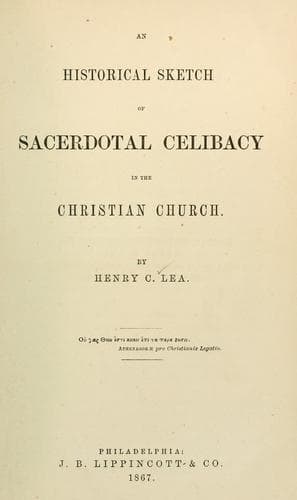
An Historical Sketch of Sacerdotal Celibacy in the Christian ChurchLea, Henry Charles
History
An Historical Sketch of Sacerdotal Celibacy in the Christian Church
Lea, Henry Charles
Catholic Church -- Clergy; Celibacy -- Catholic Church; Church history
There evidently was ample motive for a thorough reformation, and
Gregory accordingly addressed himself energetically to the work of
enforcing the canons. In his decretals there are numerous references
to the subject, showing that he lost no opportunity of reviving the
neglected rules of discipline regarding the ordination of digami,[264]
the residence of women, and abstinence from all intercourse with
the sex.[265] In his zeal he even went so far as to decree that any
one guilty of even a single lapse from virtue should be forever
debarred from the ministry of the altar[266]—a law nullified by its
own severity, which rendered its observance impossible. In 587, his
predecessor Pelagius had ordered that in Sicily the Roman rule should
be followed of separating subdeacons from their wives, but it appeared
cruel to Gregory that this should be enforced on those who had no
warning of such rigor when accepting the subdiaconate, and one of the
earliest acts of his pontificate was to allow them to resume relations
with their wives; but he ordered that they should abstain from all
service of the altar, and that in future no one should be admitted to
that grade who would not formally take a vow of continence.[267] There
is not much trace in contemporary history of any improvement resulting
from these efforts, and towards the very close of his pontificate,
in 602, we find him entreating Queen Brunhilda to exercise her power
in restraining the still unbridled license of the Frankish clergy—a
task which he assures her is essential if she desires to transmit
her possessions in peace to her posterity.[268] He also endeavored
to reform the perennial abuse of the residence of women, a reform
which the church has been vainly attempting ever since the canon of
Nicæa.[269] That Gregory’s zeal, however, exercised some influence is
manifested by the fact that tradition in the Middle Ages occasionally
associated his name with the introduction of celibacy in the church.
The impression which he produced is shown by the wild legend which
relates that, soon after issuing and strictly enforcing a decretal on
the subject, he happened to have his fishponds drawn off, when the
heads of no less than six thousand infants were found in them—the
offspring of ecclesiastics, destroyed to avoid detection—which filled
him with so much horror that he abandoned the vain attempt.[270] Yet in
Italy the residence of wives was still permitted to those in orders,
under the restriction that they should be treated as sisters;[271]
and Gregory relates as worthy of all imitation the case of a holy
priest of Nursia who, following the example of the saints in depriving
himself of even lawful indulgences, had persistently relegated his
wife to a distance. When at length he lay on his death-bed, to all
appearance inanimate, the wife came to bid him a last farewell, and
placed a mirror to his lips, to see whether life was yet extinct. Her
Public-domain text, read in full here on John Shaqi.
Reviews
Reviews
No reviews yet
Be the first to share your thoughts on this work.
Elsewhere in the archive
Join the Discussion
Join the discussion
Sign in to leave a comment or review.
Sign InorCreate an account