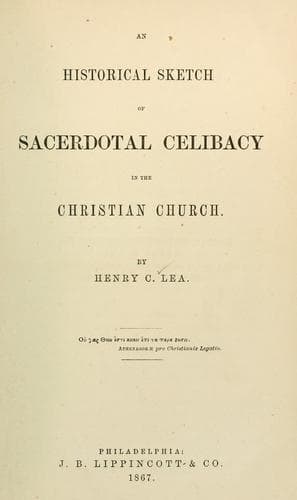
An Historical Sketch of Sacerdotal Celibacy in the Christian ChurchLea, Henry Charles
History
An Historical Sketch of Sacerdotal Celibacy in the Christian Church
Lea, Henry Charles
Catholic Church -- Clergy; Celibacy -- Catholic Church; Church history
kindly ministrations roused the dominant asceticism in his expiring
soul, and he gathered strength enough to exclaim, “Woman, depart!
Take away the straw, for there is yet fire here”—which supreme effort
of self-immolation procured him on the instant a beatific vision of
St. Peter and St. Paul, during which he lapsed ecstatically into
eternity.[272]
In considering so thoroughly artificial a system of morality, it is
perhaps scarcely worth while to inquire into the value of a virtue
which could only be preserved by shunning temptation with so scrupulous
a care.
IX.
THE CARLOVINGIANS.
Even the energy and authority of Gregory the Great were powerless to
restore order in the chaos of an utterly demoralized society. In Spain,
the languishing empire of the Wisigoths was fast sinking under the
imbecility which invited the easy conquest of the Saracens. In France,
Brunhilda and Fredegonda were inflaming the fierce contentions which
eventually destroyed the Merovingian dynasty, and which abandoned the
kingdom at once to the vices of civilization and the savage atrocities
of barbarism.[273] In Italy, the Lombards, more detested than any of
their predecessors, by their ceaseless ravages made the Ostrogothic
rule regretted, and gleaned with their swords such scanty remnants of
plunder as had escaped the hordes which had successively swept from the
gloomy forests of the North across the rich valleys and fertile plains
of the mistress of the world. Anarchy and confusion everywhere scarce
offered a field for the exercise of the humbler virtues, nor could the
church expect to escape the corruption which infected every class from
which she could draw her recruits. Still, amid the crowd of turbulent
and worldly ecclesiastics, whose only aim was the gratification of the
senses or the success of criminal ambition, some holy men were to be
found who sought the mountain and forest as a refuge from the ceaseless
and all-pervading disorder around them. St. Gall and St. Columba,
Willibrod and Boniface, were types of these. Devoted to the severest
asceticism, burying themselves in the wilderness and subsisting on such
simple fare as the labor of their hands could wring from a savage land,
the selfishness of the anchorite did not extinguish in them the larger
aims of the Christian, and by their civilizing labors among the heathen
they proved themselves worthy disciples of the Apostles.
Public-domain text, read in full here on John Shaqi.
Reviews
Reviews
No reviews yet
Be the first to share your thoughts on this work.
Elsewhere in the archive
Join the Discussion
Join the discussion
Sign in to leave a comment or review.
Sign InorCreate an account