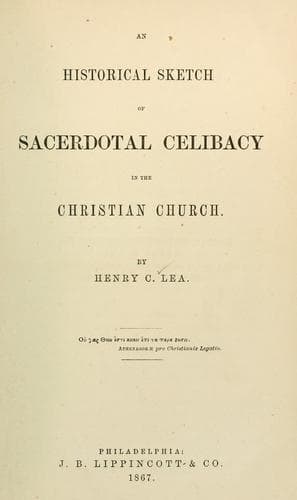
An Historical Sketch of Sacerdotal Celibacy in the Christian ChurchLea, Henry Charles
History
An Historical Sketch of Sacerdotal Celibacy in the Christian Church
Lea, Henry Charles
Catholic Church -- Clergy; Celibacy -- Catholic Church; Church history
Thicker grew the darkness as Tarik drove the Gothic fugitives before
him on the plains of Xeres, and as the house of Pepin d’Heristel
gradually supplanted the long-haired descendants of Clovis. The
Austrasian Mayors of the Palace had scanty reverence for mitre and
crozier, and it is a proof how little hold the clergy had earned upon
the respect and affection of the people, when the usurpers in that long
revolution did not find it necessary to conciliate their support. In
fact, the policy of those shrewd and able men was rather to oppress
the church and to parcel out its wealth and dignities among their
warriors, who made no pretence of piety nor deigned to undertake the
mockery of religious duties. Rome could interpose no resistance to
these abuses, for, involved alternately in strife with the Lombards and
the Iconoclastic Emperors, the Popes implored the aid of the oppressor
himself, and were in no position to protest against the aggressions
which he might commit at home.
In Italy, the condition of discipline may be inferred from the fact
that, in 721, Gregory II. considered it necessary to call a synod for
the special purpose of condemning incestuous unions and the marriages
of nuns, which he declared were openly practised,[274] and the canons
then promulgated received so little attention that they had to be
repeated by another synod in 732.[275] In fact, the vow of chastity was
frequently taken by widows that they might escape a second marriage
and thus be able to live in shameless license without being subject
to the watchful control of a husband, and an edict of Arechis Duke of
Beneventum about the year 774 orders that all such godless women shall
be seized and shut up in convents.[276] That the secular clergy should
consider ordination no bar to matrimony need therefore excite little
surprise. There is extant a charter of Talesperianus, Bishop of Lucca,
in 725, by which he confirms a little monastery and hospital to Romuald
the priest and his wife—“presbiteria sua.” The document recites that
this couple had come on a pilgrimage from beyond the Po; that they had
settled in the lands of the Convent of St. Peter and St. Martin in the
diocese of Lucca, where they had bought land and built the institution
which the good bishop thus confirms to them with certain privileges.
He evidently felt that there was nothing irregular in their maintaining
the connection, and he lays upon them no conditions of separation.[277]
Public-domain text, read in full here on John Shaqi.
Reviews
Reviews
No reviews yet
Be the first to share your thoughts on this work.
Elsewhere in the archive
Join the Discussion
Join the discussion
Sign in to leave a comment or review.
Sign InorCreate an account