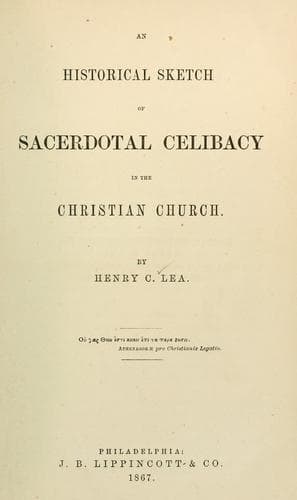
An Historical Sketch of Sacerdotal Celibacy in the Christian ChurchLea, Henry Charles
History
An Historical Sketch of Sacerdotal Celibacy in the Christian Church
Lea, Henry Charles
Catholic Church -- Clergy; Celibacy -- Catholic Church; Church history
That he should have escaped, indeed, is surprising, when the character
of the age is considered, and the nature of the evils inflicted on
those who must have regarded the reform as a wanton outrage on their
rights. As late as 748, Boniface describes the false bishops and
priests, sacrilegious and wandering hypocrites and adulterers, as much
more numerous than those who as yet had been forced to compliance with
the rules. Driven from the churches, but supported by the sympathizing
people, they performed their ministry among the fields and in the
cabins of the peasants, who concealed them from the ecclesiastical
authorities.[298] This is not a description of mere sensual worldlings,
and it is probable that by this time persecution had ranged the
evil-disposed on the winning side. Those who thus exercised their
ministry in secret and in wretchedness, retaining the veneration of
the people, were therefore men who believed themselves honorably and
legitimately married, and who were incapable of sacrificing wife and
children for worldly advantage or in blind obedience to a rule which to
them was novel, unnatural, and indefensible.
Boniface escaped from the vengeful efforts of those who suffered from
his zeal, to fall, in 755, under the sword of the equally ungrateful
Frisians. It is probable that up to the time of his death he was
occupied with the reformation of the clergy in conjunction with his
missionary labors, for in 752 we find him still engaged in the hopeless
endeavor to eject the unclerical prelates, who even yet held over from
the iron age of Charles Martel. His disappearance from the scene,
however, made but little change in the movement which had owed so much
to his zeal.
* * * * *
In 747 Carloman’s pious aspirations had led him from a throne to
a cloister, and the monastery of Monte Casino welcomed its most
illustrious inmate. Pepin received the whole vast kingdom, and
his ambitious designs drew him daily closer to the church, the
importance of whose support he commenced to appreciate. His policy,
in consolidating the power of his house and in founding a new
dynasty, led him necessarily to reorganize the anarchical elements
of society. As an acknowledged monarch, a regularly constituted
hierarchy and recognized subordination to the laws, both civil and
ecclesiastical, were requisite to the success of his government and to
the establishment of his race. Accordingly, we find him carrying out
systematically the work commenced by Carloman and Boniface, to which at
first his support had been rather negative than positive.
Public-domain text, read in full here on John Shaqi.
Reviews
Reviews
No reviews yet
Be the first to share your thoughts on this work.
Elsewhere in the archive
Join the Discussion
Join the discussion
Sign in to leave a comment or review.
Sign InorCreate an account