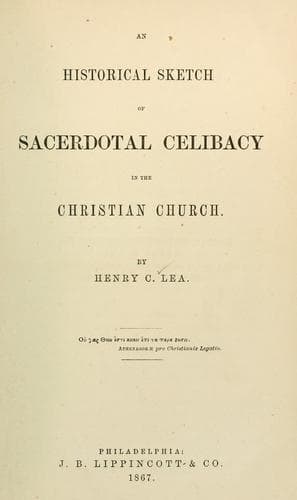
An Historical Sketch of Sacerdotal Celibacy in the Christian ChurchLea, Henry Charles
History
An Historical Sketch of Sacerdotal Celibacy in the Christian Church
Lea, Henry Charles
Catholic Church -- Clergy; Celibacy -- Catholic Church; Church history
tacit permission of priestly marriage, while avoiding an open avowal.
It need awaken no surprise if those who united recklessness and power
should openly trample on the canons thus feebly supported. A somewhat
prominent personage of the period was Hubert, brother of Teutberga,
Queen of Lotharingia, and his turbulent conduct was a favorite theme
for animadversion by the quiet monastic chroniclers. That he was an
abbot is perhaps no proof of his clerical profession, but when we find
his wife and children alluded to as a proof of his abandoned character,
it shows that he was bound by vows or ordained within the prohibited
grades, and that he publicly violated the rules and defied their
enforcement.[322]
The earliest absolute evidence that has reached us, however, of
marriage committed by a member of the great body of the plebeian
clergy, subsequent to the reforms of Boniface, occurs about the year
893. Angelric priest of Vasnau appealed to the synod of Chalons,
stating that he had been publicly joined in wedlock to a woman named
Grimma. Such an attempt by a priest, the consent of the woman and
her relatives, and the performance of the ceremony by another priest
all show the prevailing laxity and ignorance, yet still there were
found some faithful and pious souls to object to the transaction, and
Angelric was not allowed to enjoy undisturbed the fruits of his sin.
Yet even the synod was perplexed, and unable to decide what ought to be
done. It therefore only temporarily suspended Angelric from communion,
while Mancio, his bishop, applied for advice to Foulques of Rheims,
metropolitan of the province, and the ignorance and good faith of all
parties are manifested by the fact that Angelric himself was sent to
Foulques as the bearer of the letter of inquiry.[323]
With the ninth century the power, the cultivation, and the civilization
of the Carlovingians may be considered virtually to disappear, though
for nearly a hundred years longer a spectral crown encircled the brows
of the ill-starred descendants of Pepin. Centralization, rendered
impossible in temporal affairs by feudalism, was transferred to the
church, which, thenceforth, more than ever independent of secular
control, became wholly responsible for its own shortcomings; and the
records of the period make only too plainly manifest how utterly the
power, so strenuously contended for, failed to overcome the ignorance
and the barbarism of the age.
X.
THE TENTH CENTURY.
Public-domain text, read in full here on John Shaqi.
Reviews
Reviews
No reviews yet
Be the first to share your thoughts on this work.
Elsewhere in the archive
Join the Discussion
Join the discussion
Sign in to leave a comment or review.
Sign InorCreate an account