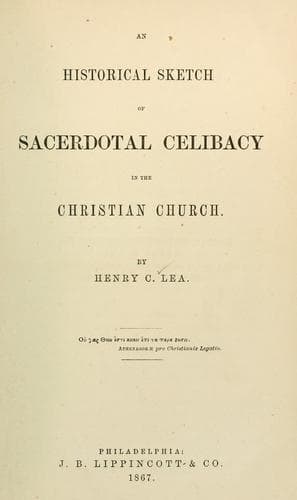
An Historical Sketch of Sacerdotal Celibacy in the Christian ChurchLea, Henry Charles
History
An Historical Sketch of Sacerdotal Celibacy in the Christian Church
Lea, Henry Charles
Catholic Church -- Clergy; Celibacy -- Catholic Church; Church history
in shielding the guilty. If, as we can readily believe was generally
the case, these formidable difficulties could not be overcome, and the
necessary number of witnesses were not ready to sacrifice themselves,
then the accused could purge himself of the sins imputed to him by
his own oath, supported by one, three, or six compurgators of his
own order; and Hincmar himself bears testimony to the associations
which were formed among the clergy to swear each other through all
troubles.[318] Even simpler, indeed, was the process prescribed not
long before by Pope Nicholas I., who ordered that when legal evidence
was not procurable, the accused priest could clear himself on his own
unsupported oath.[319]
Under these regulations, Hincmar orders an annual investigation to be
made throughout his province, but the results would appear to have been
as unsatisfactory as might have been expected. In 874, at the Synod of
Rheims, he complains that his orders have been neglected and despised,
and he warns his clergy that proof of actual criminality will not be
required, but that undue familiarity with women, if persisted in, will
be sufficient for condemnation when properly proved.[320]
In the presence of facilities for escape such as were afforded by the
practice of ecclesiastical law as constructed by the decretalists,
and as expounded by Hincmar himself, the threats in which he indulged
could carry but little terror. We need not wonder, therefore, if we
meet with but slender indications of priestly marriage during all this
disorder, for there was evidently little danger of punishment for
the unchaste priest who exercised ordinary discretion in his amours,
while the penalties impending over those who should openly brave the
canonical rules were heavy, and could hardly be avoided by any one who
should dare to unite himself publicly to a woman in marriage. Every
consideration of worldly prudence and passion therefore induced the
priest to pursue a course of illicit licentiousness—and yet, as the
century wore on, traces of entire neglect or utter contempt of the
canons began to manifest themselves. How little the rule really was
respected by the ecclesiastical authorities, when anything was to be
gained by its suppression, is shown in the decision made by Nicholas
I., the highest of high churchmen, when encouraging the Bulgarians to
abandon the Greek church, although the separation between Rome and
Constantinople was not, as yet, formal and complete. To their inquiry
whether married priests should be ejected, he replied that though such
ministers were objectionable, yet the mercy of God was to be imitated,
who causes his sun to shine on good and evil alike, and as Christ did
not dismiss Judas, so they were not to be dismissed. Besides, laymen
were not to judge priests for any crime, nor to make any investigation
into their lives, such inquiries being reserved for bishops.[321] As
no bishops had yet been appointed by Rome, the answer was a skilfully
Public-domain text, read in full here on John Shaqi.
Reviews
Reviews
No reviews yet
Be the first to share your thoughts on this work.
Elsewhere in the archive
Join the Discussion
Join the discussion
Sign in to leave a comment or review.
Sign InorCreate an account