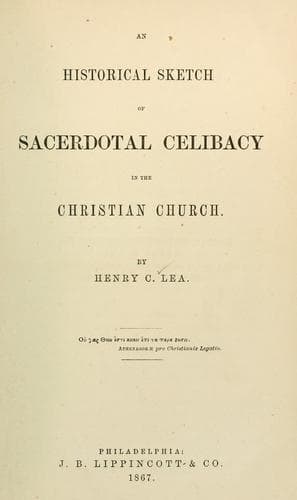
An Historical Sketch of Sacerdotal Celibacy in the Christian ChurchLea, Henry Charles
History
An Historical Sketch of Sacerdotal Celibacy in the Christian Church
Lea, Henry Charles
Catholic Church -- Clergy; Celibacy -- Catholic Church; Church history
With such corruption at the head of the church, it is lamentably
ludicrous to see the popes inculcating lessons of purity, and urging
the maintenance of canons which they set the example of disregarding
so utterly. The clergy were now beginning to arrogate to themselves
the privilege of matrimony; and marriage, so powerful a corrective of
indiscriminate vice, was regarded with peculiar detestation by the
ecclesiastical authorities, and awoke a far more energetic opposition
than the more dangerous and corrupting forms of illicit indulgence. The
pastor who intrigued in secret with his penitents and parishioners was
scattering the seeds of death in place of the bread of life, and was
abusing his holy trust to destroy the souls confided to his charge,
but this worked no damage to the temporal interests of the church at
large. The priest who, in honest ignorance of the canons, took to
himself a wife, and endeavored faithfully to perform the duties of his
humble sphere, could scarcely avoid seeking the comfort and worldly
welfare of his offspring, and this exposed the common property of all
to dilapidation and embezzlement. Disinterested virtue perhaps would
not be long in making a selection between the comparative evils, but
disinterested virtue was not a distinguishing characteristic of the age.
Yet a motive of even greater importance than this rendered matrimony
more objectionable than concubinage or licentiousness. By the
overruling tendency of the age, all possessions previously held by
laymen on precarious tenure were rapidly becoming hereditary. As the
royal power slipped from hands unable to retain it, offices, dignities,
and lands became the property of the holders, and were transmitted from
father to son. Had marriage been openly permitted to ecclesiastics,
their functions and benefices would undoubtedly have followed the
example. An hereditary caste would have been established, who would
have held their churches and lands of right; independent of the central
authority, all unity would have been destroyed, and the collective
power of the church would have disappeared. Having nothing to gain from
obedience, submission to control would have become the exception, and,
laymen in all but name, the ecclesiastics would have had no incentive
to perform their functions, except what little influence, under such
circumstances, might have been retained over the people by maintaining
the sacred character thus rendered a mockery.
Public-domain text, read in full here on John Shaqi.
Reviews
Reviews
No reviews yet
Be the first to share your thoughts on this work.
Elsewhere in the archive
Join the Discussion
Join the discussion
Sign in to leave a comment or review.
Sign InorCreate an account