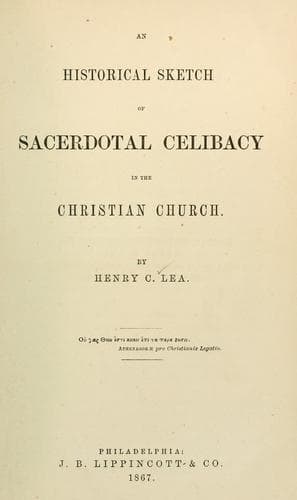
An Historical Sketch of Sacerdotal Celibacy in the Christian ChurchLea, Henry Charles
History
An Historical Sketch of Sacerdotal Celibacy in the Christian Church
Lea, Henry Charles
Catholic Church -- Clergy; Celibacy -- Catholic Church; Church history
In an age when everything was unsettled, yet with tendencies so
strongly marked, it thus became a matter of vital importance to the
church to prevent anything like hereditary occupation of benefices
or private appropriation of property, and against these abuses its
strongest efforts were directed. The struggle lasted for centuries, and
it is indeed most fortunate for our civilization that sacerdotalism
triumphed, even at the expense of what at the moment may appear of
greater importance. I cannot here pause to trace the progress of
the contest in its long and various vicissitudes. It will be found
constantly reappearing in the course of the following pages, and for
the present it will suffice to group together a few evidences to show
how rapidly the hereditary tendency developed itself in the period
under consideration.
The narrowness of the escape from ecclesiastical feudalization is
well illustrated by an incident at the council of Tours, in 925,
where two priests, _father and son_, Ranald and Raymond, appeared as
complainants, claiming certain tithes detained from them by another
priest. They gained the suit, and the tithes were confirmed to them and
their successors forever.[326] Even more suggestive is the complaint,
some thirty years later, of Ratherius, Bishop of Verona, who objects
strenuously to the ordination of the children sprung from these
illegal marriages, as each successive father made his son a priest,
thus perpetuating the scandal indefinitely throughout the church;
and as he sorrowfully admits that his clergy could not be restrained
from marriage, he begs them at least to bring their children up as
laymen.[327] This, however, by his own showing, would not remove the
material evil, for in another treatise he states that his priests and
deacons divided the church property between them, that they might have
lands and vineyards wherewith to provide marriage portions for their
sons and daughters.[328] This system of appropriation also forms the
subject of lamentation for Atto, Bishop of Vercelli, whose clergy
insisted on publicly keeping concubines—as he stigmatizes those who
evidently were wives—to whom they left by will everything that they
could gather from the possessions of the church, from the alms of
the pious, or from any other source, to the ruin of ecclesiastical
property and to the deprivation of the poor.[329] How well founded were
these complaints is evident from a document of the eleventh century
concerning the churches of St. Stephen and St. Donatus in Aretino.
The priests in charge appropriated to themselves all the possessions
of the churches, including the revenues of the altars, the oblations,
and the confessional. These they portioned out among each other and
handed down from father to son as regularly as any other property,
selling and exchanging their shares as the interest of the moment might
suggest, and the successive transmission of each fragment of property
Public-domain text, read in full here on John Shaqi.
Reviews
Reviews
No reviews yet
Be the first to share your thoughts on this work.
Elsewhere in the archive
Join the Discussion
Join the discussion
Sign in to leave a comment or review.
Sign InorCreate an account