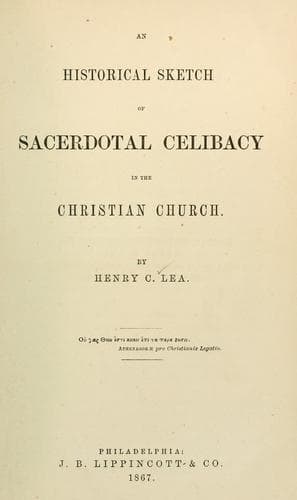
An Historical Sketch of Sacerdotal Celibacy in the Christian ChurchLea, Henry Charles
History
An Historical Sketch of Sacerdotal Celibacy in the Christian Church
Lea, Henry Charles
Catholic Church -- Clergy; Celibacy -- Catholic Church; Church history
It will be observed that, as the century advanced, sacerdotal marriage
became more and more common. Indeed, in 966, Ratherius not only
intimates that his clergy all were married, but declares that if the
canon prohibiting repeated marriages were put in force, only boys would
be left in the church, while even they would be ejected under the rule
which rendered ineligible the offspring of illicit unions;[332] and,
in spite of his earnest asceticism, he only ventures to prohibit his
clergy from conjugal intercourse during the periods likewise forbidden
to laymen, such as Advent, Christmas, Lent, etc.[333] It was not that
the ancient canons were forgotten,[334] nor that strenuous efforts were
not made to enforce them, but that the temper of the times created
a spirit of personal independence so complete that the power of the
ecclesiastical authorities seemed utterly inadequate to control the
growing license. About the year 938, Gerard, Archbishop of Lorsch
and Papal Legate for Southern Germany, laid before Leo VII. a series
of questions relating to various points in which the ancient canons
were set at naught throughout the region under his supervision. Leo
answered by a decretal addressed to all the princes and potentates
of Europe, in which he laments over Gerard’s statement of the public
marriages of priests, and replies to his inquiry as to the capacity of
their children for ecclesiastical promotion. The first he pronounces
forbidden by the canons, and those guilty of it he orders to be
deprived of their benefices. As for the offspring of such marriages,
however, he says that they are not involved in the sins of their
parents.[335]
The unusual liberality of this latter declaration, however, was not
a precedent. The church always endeavored to prevent the ordination
of the children of ecclesiastics, and Leo, in permitting it, was only
yielding to a pressure which he could not withstand. It was a most
dangerous concession, for it led directly to the establishment of the
hereditary principle. An effort was soon after made, by an appeal to
the temporal power, to recover the ground lost, and about the year 940
Otho the Great was induced to issue an edict prohibiting the sons of
deacons, priests, and bishops from occupying the positions of notary,
judge, or count[336]—the bare necessity of which shows how numerous and
powerful the class had already become.
* * * * *
Public-domain text, read in full here on John Shaqi.
Reviews
Reviews
No reviews yet
Be the first to share your thoughts on this work.
Elsewhere in the archive
Join the Discussion
Join the discussion
Sign in to leave a comment or review.
Sign InorCreate an account