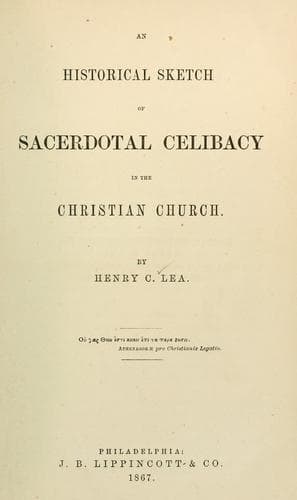
An Historical Sketch of Sacerdotal Celibacy in the Christian ChurchLea, Henry Charles
History
An Historical Sketch of Sacerdotal Celibacy in the Christian Church
Lea, Henry Charles
Catholic Church -- Clergy; Celibacy -- Catholic Church; Church history
Although, as early as 925, the council of Spalatro seemed to find
nothing to condemn in a single marriage, but threatened excommunication
against those who so far forgot themselves as to contract a
second,[337] and though by the middle of the century the practice had
become generally established, yet some rigid prelates continued to
keep alive the memory of the ancient canons by fruitless protests and
ineffectual efforts at reform. In 948, the synod of Engelheim, under
the presidency of Marino, Bishop of Ostia and Papal Vicar, condemned
such marriages as incestuous and unlawful.[338] In 952, at the council
of Augsburg, the assembled German and Italian prelates made a further
and more desperate effort. Deposition was pronounced against the
subdeacon, deacon, priest, or bishop who should take to himself a
wife; separation of those already married was ordered, and even the
lower grades of the clergy, who had not previously been subjected to
any such rule, were commanded to observe the strictest continence. An
attempt was also made to prevent concubinage by visiting suspected
women with stripes and shaving; but there evidently was some difficulty
anticipated in enforcing this, for the royal power is invoked to
prevent secular interference with the sentence.[339]
This stringent legislation of course proved utterly nugatory, but,
futile as it was, it yet awakened considerable opposition. St. Ulric,
in whose episcopal town of Augsburg the council was held, addressed
a long epistle to the Pope, remonstrating against his efforts to
enforce the rule of celibacy, and arguing the question, temperately
but forcibly, on the grounds both of scriptural authority and of
expediency. He pointed out how much more obnoxious to Divine wrath
were the promiscuous and nameless crimes indulged in by those who
were foremost in advocating the reform, than the chaste and single
marriages of the clergy; and the violent distortion of the sacred
texts, by those who sought authority to justify the canon, he not
unhappily characterized as straining the breast of Scripture until it
yielded blood in place of milk.[340]
Public-domain text, read in full here on John Shaqi.
Reviews
Reviews
No reviews yet
Be the first to share your thoughts on this work.
Elsewhere in the archive
Join the Discussion
Join the discussion
Sign in to leave a comment or review.
Sign InorCreate an account