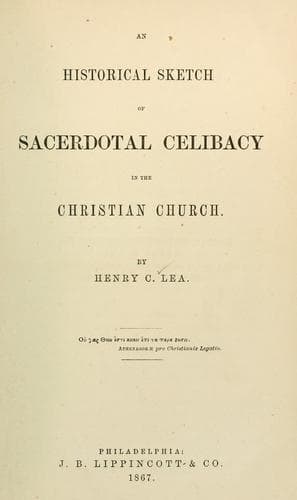
An Historical Sketch of Sacerdotal Celibacy in the Christian ChurchLea, Henry Charles
History
An Historical Sketch of Sacerdotal Celibacy in the Christian Church
Lea, Henry Charles
Catholic Church -- Clergy; Celibacy -- Catholic Church; Church history
Despite the inefficiency of these attempts, the clergy were not always
allowed to enjoy their unlawful domestic ties in peace, and, where
the votaries of asceticism were bold and determined, the contest was
sometimes severe. The nature of the struggle is well illustrated by the
troubles which arose between Ratherius of Verona and the ecclesiastics
of his diocese. In April, 967, John XIII. held a council at Ravenna
which commanded those who were in holy orders to give up at once
either their wives or their ministry, and Otho the Great was induced
to issue a precept confirming this peremptory decree. Ratherius had
long been vainly wishing for some authority on the subject more potent
than the ancient and now obsolete canons, and on his return from
Ravenna he summoned a synod for the purpose of promulgating the new
regulations. His clergy got wind of his intention; very few of them
obeyed the summons, and most of those who came boldly declared that
they would neither be separated from their wives nor abandon their
functions; in fact, they did not scruple to maintain that marriage was
not only permissible, but even necessary to protect the church from
the most hideous vices. The utmost concession he could obtain, indeed,
came from a few who endeavored to excuse themselves on the ground of
poverty, which did not enable them to live without the assistance of
their wives, and who professed to be willing to separate from them if
they could be assured of a regular stipend.[341] Ratherius had passed
through too many vicissitudes in his long and agitated career to shrink
from the collision, now that he was backed by both the papal and
imperial authority. He promptly threw the recalcitrant pastors into
prison, declaring that they should lie there until they paid a heavy
fine for the benefit of the cathedral of the Virgin, and he further
commanded the presence of those who had failed to appear. The clergy
of the diocese, finding that the resistance of inertia was unavailing,
took more decided steps, and appealed for protection to the temporal
power, in the person of Nanno, Count of Verona. He promptly espoused
their cause, and his _missus_ Gilbert forbade their obedience to the
summons of their bishop for a year. Ratherius remonstrated vehemently
against the assumption of Nanno that the priests were his vassals,
subject to his jurisdiction, and entitled to protection, and he lost
no time in invoking the power of Otho, in a letter to Ambrose, the
Imperial Chancellor.[342] The clergy were too powerful; the imperial
court decided against the bishop, and before the end of the year
Ratherius was forced to retire from the unequal contest and to take
refuge in the peaceful abbey of Lobbes, whence he had been withdrawn a
quarter of a century before to fill the see of Verona. Three times had
he thus been driven from that city, and an intermediate episcopate of
Liége, with which one of his periods of exile was gratified, had been
Public-domain text, read in full here on John Shaqi.
Reviews
Reviews
No reviews yet
Be the first to share your thoughts on this work.
Elsewhere in the archive
Join the Discussion
Join the discussion
Sign in to leave a comment or review.
Sign InorCreate an account