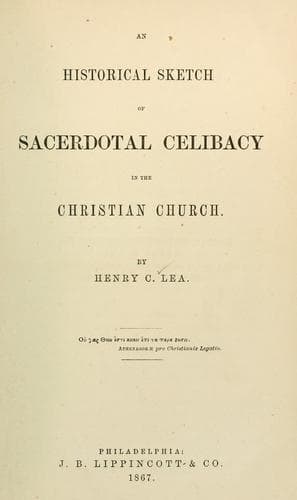
An Historical Sketch of Sacerdotal Celibacy in the Christian ChurchLea, Henry Charles
History
An Historical Sketch of Sacerdotal Celibacy in the Christian Church
Lea, Henry Charles
Catholic Church -- Clergy; Celibacy -- Catholic Church; Church history
How completely, indeed, marriage came to be regarded as a matter of
course is manifest when, in 1019, an assembly of German bishops, with
the Emperor St. Henry at their head, gravely deliberated over the
knotty question whether, when a noble permitted his serf to enter into
holy orders, and the serf, presuming upon his new-born dignities and
the wealth of his benefices, married a free woman and endeavored to
withhold his children from the servitude which he still owed to his
master, such infraction of his master’s rights could be permitted out
of respect to his sacerdotal character. Long and vehement was the
argument among the learned prelates, until finally St. Henry decided
the point authoritatively by pronouncing in favor of the servitude of
the children.[357]
But perhaps the most instructive illustration of the character and
temper of the age may be found in the three prelates who for more than
a century filled the rich and powerful archiepiscopal see of Rouen.
Hugh, whose episcopate lasted from 942 to 989, was nominated at a
period when William Longsword, Duke of Normandy, was contemplating
retirement from the world to shroud his almost regal dignity under the
cowl of the monk, yet what little is known of his archbishop is that,
though he was a monk in habit, he was an habitual violator of the laws
of God[358]—in short, we may presume, a man well suited to the wild
half-pagan times which witnessed the assassination of Duke William
and the minority of Richard the Fearless. On his death, in 989, Duke
Richard, whose piety was incontestably proved by the liberality of his
monastic foundations and by his zeal for the purity of his monkish
protégés,[359] filled the vacant see with his son Robert, who held the
position until 1037. Robert was publicly and openly married, and by
his wife Herleva he had three sons, Richard, Rodolf, and William, to
whom he distributed his vast possessions. Ordericus, the conscientious
cenobite of the twelfth century, looks, in truth, somewhat askance
at this disregard of the rules accepted in his own time,[360] yet
no blame seems to have attached to Robert in the estimation of his
contemporaries. The family chronicler characterizes him as “Robert bons
clers, honestes hom,” and assures us that he was highly esteemed as a
wise and learned prelate
Li secunz fu genz e aperz
Et si fu apelez Roberz.
Clerc en firent, mult aprist bien,
Si fi sage sor tote rien;
De Roem out l’arcevesquié
Honoré fu mult e preisié.[361]
Public-domain text, read in full here on John Shaqi.
Reviews
Reviews
No reviews yet
Be the first to share your thoughts on this work.
Elsewhere in the archive
Join the Discussion
Join the discussion
Sign in to leave a comment or review.
Sign InorCreate an account