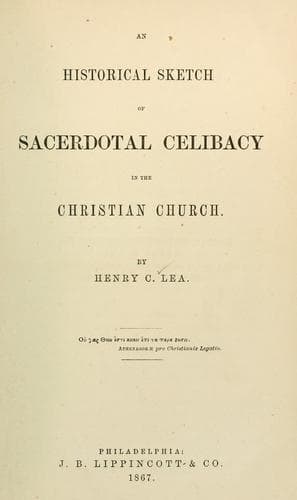
An Historical Sketch of Sacerdotal Celibacy in the Christian ChurchLea, Henry Charles
History
An Historical Sketch of Sacerdotal Celibacy in the Christian Church
Lea, Henry Charles
Catholic Church -- Clergy; Celibacy -- Catholic Church; Church history
His successor, Mauger, son of Duke Richard II., and archbishop from
1037 to 1054, was worthy of his predecessors. Abandoned to worldly and
carnal pleasures, his _legitimate_ son Michael was a distinguished
knight, and half a century later stood high in the favor of Henry I. of
England, in whose court he was personally known to the historian.[362]
The times were changing, however, and Mauger felt the full effects of
reformatory zeal, for he was deposed in 1054; the see was bestowed on
St. Maurilio, a Norman, who as abbot of Santa Maria in Florence had
been driven out and nearly poisoned to death by his monks on account
of the severity of his rule, and the Norman clergy, as we shall see
hereafter, experienced their share of suffering in the mutation of
discipline.
* * * * *
Notwithstanding this all-pervading laxity, the canons of the church
remained unaltered, and their full force was theoretically admitted.
Hopeless efforts, moreover, were occasionally made to re-establish
them, as in the council of Anse in 990, which reminded the clergy that
intercourse with wives after ordination was punishable with forfeiture
of benefice and deprivation of priestly functions;[363] and in that
of Poitiers about the year 1000, which prohibited concubines under
pain of degradation.[364] In a similar spirit, a Penitential of the
period recapitulates the severe punishments of a former age, involving
degradation and fearfully long terms of penance.[365] All this,
however, was practically a dead letter. The person who best represents
the active intelligence of the age was Gerbert of Aurillac, the most
enlightened man of his time, who, after occupying the archiepiscopal
seats of Rheims and Ravenna, finally became pope under the name of
Silvester II. The lightness with which he treats the subject of
celibacy is therefore fairly a measure of the views entertained by the
ruling spirits of the church, beyond the narrow bounds of cloistered
asceticism. Gerbert, describing in a sermon the requisites of the
episcopal and sacerdotal offices, barely refers to the “unius uxoris
vir,” which he seems to regard in an allegorical rather than in a
literal sense; he scarcely alludes to chastity, while he dilates with
much energy on simony, which he truly characterizes as the almost
universal vice of his contemporaries.[366] So when, in 997, he convened
the council of Ravenna to regulate the discipline of his church,
he paid no attention whatever to incontinence, while strenuously
endeavoring to root out simony.[367] At an earlier period, while Abbot
of Bobbio, in an epistle to his patron, the Emperor Otho II., refuting
various calumnies of his enemies, he alludes to a report of his having
a wife and children in terms which show how little importance he
attached to the accusation.[368]
Public-domain text, read in full here on John Shaqi.
Reviews
Reviews
No reviews yet
Be the first to share your thoughts on this work.
Elsewhere in the archive
Join the Discussion
Join the discussion
Sign in to leave a comment or review.
Sign InorCreate an account