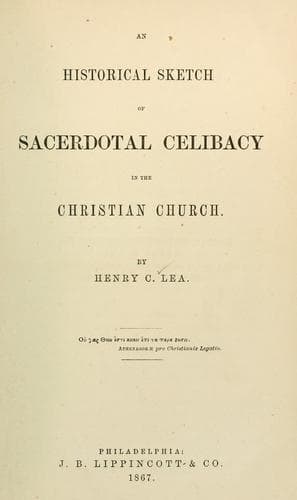
An Historical Sketch of Sacerdotal Celibacy in the Christian ChurchLea, Henry Charles
History
An Historical Sketch of Sacerdotal Celibacy in the Christian Church
Lea, Henry Charles
Catholic Church -- Clergy; Celibacy -- Catholic Church; Church history
* * * * *
When, a hundred and fifty years after the Anglo-Saxon invasion, Gregory
the Great undertook the conversion of the islanders, the missionaries
whom he despatched under Augustin of course carried with them the views
and ideas which then held undisputed sway in Rome. Apparently, however,
asceticism found little favor at first with the new converts, rendering
it difficult for Augustin to obtain sufficient co-laborers among his
disciples, for he applied to Gregory to learn whether he might allow
those who could not restrain their passions to marry and yet remain
in the ministry. To this Gregory replied evasively, stating, what
Augustin already knew, that the lower grades might marry, but making
no reference whatever to the higher orders.[382] He apparently did not
wish to assume the responsibility of relaxing the rule, while willing
perhaps to connive at its suspension in order to encourage the infant
Anglican church. If so, the indulgence was but temporary.
The attempt has been made to prove that marriage was permitted in the
early Saxon church, and support for this supposition has been sought
from a clause in the Dooms of King Ina, of which the date is about the
year 700, fixing the wer-gild of the son of a bishop. But the rubric
of the law shows that it refers rather to a godson;[383] and even if
it were not so, we have already seen how often in France, at the same
period, the episcopal office was bestowed on eminent or influential
laymen, who were obliged on its acceptance to part with their wives.
The Magdeburg Centuriators, indeed, describe a council held in London
in 712 or 714, by which image-worship was introduced and separation
between priests and their wives was decreed,[384] but there is no
authority cited, nor is such an assembly elsewhere alluded to, even
Cave pronouncing it evidently supposititious.[385]
Public-domain text, read in full here on John Shaqi.
Reviews
Reviews
No reviews yet
Be the first to share your thoughts on this work.
Elsewhere in the archive
Join the Discussion
Join the discussion
Sign in to leave a comment or review.
Sign InorCreate an account