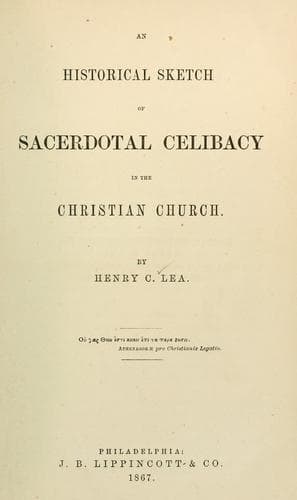
An Historical Sketch of Sacerdotal Celibacy in the Christian ChurchLea, Henry Charles
History
An Historical Sketch of Sacerdotal Celibacy in the Christian Church
Lea, Henry Charles
Catholic Church -- Clergy; Celibacy -- Catholic Church; Church history
Meanwhile, the British Isles were the theatre of another and
independent religious movement. While the Saxons were subverting
Christianity in Britain, St. Patrick was successfully engaged in laying
the foundations of the Irish church.[371] We have seen (p. 76) that
celibacy was not one of the rules enforced in the infant Irish church;
but this was of comparatively little moment, for that church was almost
exclusively monastic in its character, and preserved the strictest
views as to the observance of the vows by those who had once taken
them.[372] That the principles thus established were long preserved
is evident from a curious collection of Hibernian canons, made in the
eighth century, of which selections have been published by d’Achery
and Martène. Some of these are credited by the compilers to Gildas,
and thus show the discipline of the early British as well as of the
Irish church.[373] Their tendency is towards the purest asceticism.
A penance of forty days was even enjoined on the ecclesiastic who,
without thought of evil, indulged in the pleasure of converse with a
woman.[374] So in Ireland, a council held in 672 decrees that a priest
guilty of unchastity, although removable according to the strict
rule of discipline, may be allowed, if truly contrite, to retain his
position on undergoing ten years of penitence[375]—an alternative, one
might think, rather of severity than of mercy. One canon attributed
to Gildas shows that in the British monastic system unchastity
was considered the most heinous of offences, and also that it was
sufficiently common;[376] while another alludes to the same vice among
prelates as justifying immediate excommunication.[377]
The missionary career by which the Irish church repaid the debt
that it owed to Christianity is well known, and the form of faith
which it spread was almost exclusively monastic. Luanus, one of the
monks of Benchor, is said to have founded no less than a hundred
monasteries;[378] and when Columba established the Christian religion
in Scotland, he carried with him this tendency to asceticism and
inculcated it among his Pictish neophytes. His Rule enjoins the most
absolute purity of mind as well as body;[379] and that his teachings
were long obeyed is evident when we find that, a hundred and fifty
years later, his disciples are praised for the chastity and zeal of
their self-denying lives by the Venerable Bede, who was fully alive
to the importance of the rule, and who would have wasted no such
admiration on them had they lived in open disregard of it.[380] Equally
convincing is the fact that Scotland and the Islands were claimed to
be under the supremacy of the see of York, and that during the long
controversy requisite to break down their schismatic notions respecting
the date of Easter and the shape of the tonsure, not a word was said
that can lead to the supposition that they held any unorthodox views on
the far more important subject of sacerdotal purity.[381]
Public-domain text, read in full here on John Shaqi.
Reviews
Reviews
No reviews yet
Be the first to share your thoughts on this work.
Elsewhere in the archive
Join the Discussion
Join the discussion
Sign in to leave a comment or review.
Sign InorCreate an account