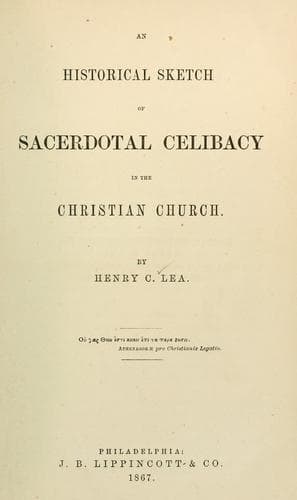
An Historical Sketch of Sacerdotal Celibacy in the Christian ChurchLea, Henry Charles
History
An Historical Sketch of Sacerdotal Celibacy in the Christian Church
Lea, Henry Charles
Catholic Church -- Clergy; Celibacy -- Catholic Church; Church history
We may fairly conclude that the discipline of the church in these
matters was reasonably well maintained by the Saxon clergy, with the
exception of the monasteries, the morals of which institutions appear
to have been deplorably and incurably loose. About the middle of the
seventh century John IV. reproves the laxity of the Saxon monasticism
under which the holy virgins did not hesitate to marry.[390] In 734 we
find Bede, in an epistle to Ecgberht of York, advising him to create
suffragan bishoprics and to endow them from the monastic foundations,
of which there were a countless number totally neglectful of all
monastic discipline, whose reformation could apparently be accomplished
in no other way.[391] St. Boniface, whose zeal on the subject has
already been sufficiently made manifest, about the year 746 paused
in his reformation of the French priesthood to urge upon Cuthbert,
Archbishop of Canterbury, the necessity of repressing the vices of
the Saxon ecclesiastics. He dwells at considerable length upon their
various crimes and misdemeanors—drunkenness, unclerical garments,
neglect of their sacred functions, &c.—but he does not accuse them
of unchastity, which he could not well have avoided doing had there
been colorable grounds for such a charge. In fact, the only allusion
connected with the question in his epistle is a request that some
restrictions should be laid upon the permissions granted to women and
nuns for pilgrimage to Rome, on account of the attendant dangers to
their virtue; in illustration of which he states the lamentable fact
that scarcely a city in Lombardy, France, or the Rhinelands but had
Saxon courtesans derived from this source, to the shame and scandal of
the whole church.[392]
Pope Zachary seconded these representations, and in 747 Cuthbert,
yielding to the impulsion, held the celebrated council of Clovesho,
which adopted thirty canons on discipline, to remedy the disorders
enumerated by Boniface. Among these, the only ones directed against
unchastity relate solely to the nunneries, which were represented as
being in a condition of gross immorality.[393] The council does not
spare the vices of the secular clergy, and its silence with respect to
their purity fairly permits the inference that there was not much to
correct with regard to it, for had licentiousness been so prevalent
that Cuthbert had feared to denounce it, or had sacerdotal marriage
been passed over as lawful, the zeal of St. Boniface would have led to
an explosion, and Zachary would not have sanctioned the proceedings by
his approval.
Public-domain text, read in full here on John Shaqi.
Reviews
Reviews
No reviews yet
Be the first to share your thoughts on this work.
Elsewhere in the archive
Join the Discussion
Join the discussion
Sign in to leave a comment or review.
Sign InorCreate an account