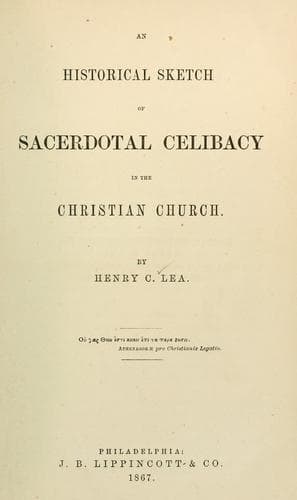
An Historical Sketch of Sacerdotal Celibacy in the Christian ChurchLea, Henry Charles
History
An Historical Sketch of Sacerdotal Celibacy in the Christian Church
Lea, Henry Charles
Catholic Church -- Clergy; Celibacy -- Catholic Church; Church history
The same argument is applicable to the council of Chelsea, held in 787
by the legates of Adrian I., under the presidency of Gregory, Bishop
of Ostia. The vices and shortcomings of the Anglican church were there
sharply reproved, but no allusion was made to any unchastity prevailing
among the priesthood, with the exception, as before, of nuns, on whom
we may infer that previous reformatory efforts had been wasted;[394]
and in an epistle from Alcuin to Ethelred King of Northumbria near
the close of the century there is the same reference to nuns, without
special condemnation of the other classes of the clergy.[395] That
this reticence did not arise from any license granted for marriage is
conclusively shown by the interpolation of the word _laicus_ in the
text I. Cor. VII. 2, which is quoted among the canons adopted.[396] To
the same effect are the canons of the council of Chelsea, in 816, in
which the only allusion to such matters is a provision to prevent the
election of unfit persons to abbacies, and to punish monks and nuns who
secularize themselves.[397]
On the other hand, it is true that about this time St. Swithun, after
obtaining orders, was openly married; but his biographer states that he
had a special dispensation from Leo III., and that he consented to it
because, on the death of his parents, he was the sole representative
of his family.[398] As Swithun was tutor to Ethelwulf, son of King
Ecgberht, the papal condescension is by no means impossible.
* * * * *
Such was the condition of the Anglo-Saxon church at this period. During
the century which follows, the materials for tracing the vicissitudes
of the question before us are of the scantiest description. The
occasional councils which were held have left but meagre records of
their deliberations, with few or no references to the subject of
celibacy. It is probable, however, that a rapid deterioration in the
strictness of discipline occurred, for even the power of the great
Bretwalda Ecgberht was unequal to the task of repressing effectually
the first invasions of the Northmen, and under his feebler successors
they grew more and more destructive, until they culminated in the
anarchy which gave occasion to the romantic adventures of Alfred.
Public-domain text, read in full here on John Shaqi.
Reviews
Reviews
No reviews yet
Be the first to share your thoughts on this work.
Elsewhere in the archive
Join the Discussion
Join the discussion
Sign in to leave a comment or review.
Sign InorCreate an account