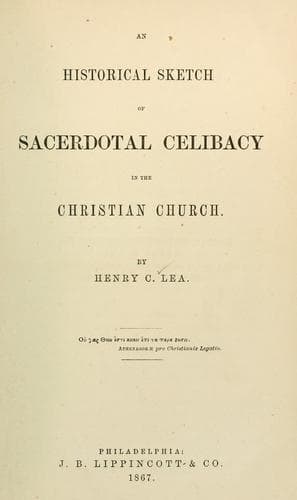
An Historical Sketch of Sacerdotal Celibacy in the Christian ChurchLea, Henry Charles
History
An Historical Sketch of Sacerdotal Celibacy in the Christian Church
Lea, Henry Charles
Catholic Church -- Clergy; Celibacy -- Catholic Church; Church history
When King Edgar made his peace with the church by consenting to the
vicarious penitence of the priesthood, three rigid and austere monks
were the ardent ministers of the royal determination. Of St. Dunstan,
the primate of England, I have already spoken. St. Ethelwold, his
pupil, Abbot of Abingdon, was elevated to the see of Winchester, and
commenced the movement by expelling the occupants of the monastery
there. A few who consented to take monastic vows were allowed to
remain, and the remainder were replaced by monks; but even St.
Ethelwold’s rigor had to bend to the depravity of the age, and he
was forced to relax the rigidity of discipline in non-essentials in
order to obtain recruits of a better class.[409] The difficulties
he encountered are indicated by the legend which relates that he
was poisoned in his wine and carried from table to his couch in
excruciating torment, where he lay hopeless till, reproaching himself
with want of faith, he repeated the text—“Et si mortiferum quid
biberint, non eis nocebitur,” and was cured on the instant.[410] That
his canons were quite capable of such an attempt may be assumed from
the description given of them in the bull procured by Dunstan from
John XIII., authorizing their ejection by the king. The pope does
not hesitate to stigmatize them as vessels of the devil, hateful to
all good Christians on account of their inveterate and ineradicable
wickedness.[411]
The third member of the reforming triumvirate was St. Oswald, Bishop
of Worcester, who undertook a similar transformation of the clergy
occupying the monastery of St. Mary in his cathedral city. Many
promises they made to conform to his wishes, and many times they
eluded the performance, till, losing patience with the prolonged
procrastination, he one day entered the chapel with a quantity of
monkish habits as they were vigorously chanting “Servite Domino in
timore,” when he made practical application of the text by forcing
them to put on the garments and take the vows on the spot, under the
alternative of instant expulsion.[412]
These proceedings met the unqualified approbation of Edgar, who in
964, by his “Charter of Oswalde’s Law,” confirmed the ejection of the
recusants who refused to part with their wives, and transferred all
their rights and possessions to the newcomers. In the same document he
boasted that he had instituted forty-seven abbeys of monks and nuns,
and that he hoped to increase the number to fifty.[413] The same year
a similar summary process was carried out in the convents of Chertsey
and Winchester;[414] and in 966 Edgar was able to boast of the numerous
religious houses throughout England which he had purified by replacing
lascivious clerks with pious monks.[415]
Public-domain text, read in full here on John Shaqi.
Reviews
Reviews
No reviews yet
Be the first to share your thoughts on this work.
Elsewhere in the archive
Join the Discussion
Join the discussion
Sign in to leave a comment or review.
Sign InorCreate an account