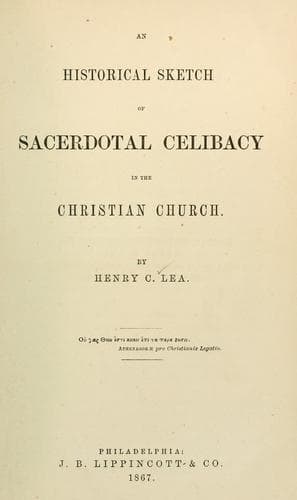
An Historical Sketch of Sacerdotal Celibacy in the Christian ChurchLea, Henry Charles
History
An Historical Sketch of Sacerdotal Celibacy in the Christian Church
Lea, Henry Charles
Catholic Church -- Clergy; Celibacy -- Catholic Church; Church history
The opportunity to effect a reformation presented itself when the young
king, Edgar the Pacific, in 963 violated all the dictates of honor
and religion in his adventure with the nun at Wilton. Her resistance
attested her innocence, and the birth of a daughter did not prevent
her subsequent canonization as St. Wilfreda; but Edgar’s crime and
remorse were only the more heightened. When the terror-stricken king
sought pardon and absolution, Dunstan was prepared with his conditions.
Seven years of penitence, during which he was to abstain from wearing
the crown, was the personal infliction imposed on him, but the most
important portion of the sentence was that by which the vices of the
king were to be redeemed by the enforced virtues of his subjects. He
promised the founding of monasteries and the reformation of the clergy;
and his implicit obedience to the demands of his ghostly judge is
shown, perhaps, less in the fact that his coronation did not take place
until 973, than in the active measures immediately set on foot with
respect to the morals of the ecclesiastics.[402]
That their morals, indeed, needed reformation is the unanimous
testimony of all the chroniclers of the period. Among all the
monasteries of England, formerly so noted for their zeal and
prosperity, only those of Glastonbury and Abingdon were inhabited by
monks.[403] The rest had fallen into ruin, or were occupied by the
secular clergy, with their wives, or worse, and were notorious as
places of the most scandalous dissipation and disorder.[404] So low
was the standard of morality that priests even scrupled not to put
away the wives of whom they grew tired, and to form new connections,
of open and public adultery;[405] and so common had this become that
a code of ecclesiastical law, probably drawn up about this time,
reproves this systematic bigamy, and appears to tacitly authorize
marriage as legitimate and honorable.[406] One author declares that
none but paupers could be found willing to bind themselves by monastic
vows;[407] and another asserts, with every show of reason, that the
clergy were not only not superior to the laity in any respect, but were
even far worse in the scandals of their daily life.[408]
Public-domain text, read in full here on John Shaqi.
Reviews
Reviews
No reviews yet
Be the first to share your thoughts on this work.
Elsewhere in the archive
Join the Discussion
Join the discussion
Sign in to leave a comment or review.
Sign InorCreate an account