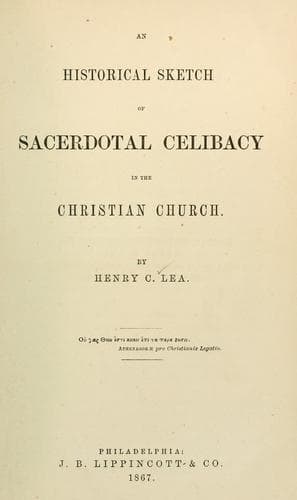
An Historical Sketch of Sacerdotal Celibacy in the Christian ChurchLea, Henry Charles
History
An Historical Sketch of Sacerdotal Celibacy in the Christian Church
Lea, Henry Charles
Catholic Church -- Clergy; Celibacy -- Catholic Church; Church history
The contumacious clerks may have been silenced; they were not subdued,
and they but waited their opportunity. It came in 975, with the early
death of Edgar and with the dissensions caused by his widow, Elfritha,
who endeavored to deprive of the succession his eldest son, the
youthful Edward, fruit of a former marriage. During the confusion,
the ejected priests banded together and bribed Elfhere, the powerful
Ealdorman of Mercia, together with some other magnates, to espouse
their cause. In many abbeys the regulars were expelled and the priests
with their wives were reinstated. In East Anglia, however, the nobles
took sides with the monks, and, rising in arms, valiantly defended
the monasteries. At length, on the accession of Edward, a council
was assembled to make final disposition of the question. The married
priests were present, and promised amendment; their noble protectors
pleaded earnestly for them; the boy-king was moved, and was about to
pronounce in their favor, when a miracle preserved the purity of the
church. The council was sitting in the refectory of the monastery of
Hyde, the headquarters of the ascetic party; Edward and Dunstan were
enthroned separately from the rest, with their backs to a wall on
which, between them, hung a small crucifix. At the critical moment,
just as the king was yielding, the crucifix spoke, in a low tone
inaudible to all save Edward and the primate, “Let not this thing be
done”—the mandate was imperative, and the married clergy lost their
cause.[420]
Still the stubborn priests and their patrons held out, and another
miracle was necessary—this time a more impressive one. A second council
was called to discuss the matter, and was held at Calne in 978. During
the heat of the argument the floor gave way, carrying with it the
whole assembly, except St. Dunstan, who remained triumphantly and
miraculously perched upon a joist, while his adversaries lay groaning
below, in every variety of mutilation.[421] His triumph, however, was
but short. The same year the pious child Edward perished through the
intrigues of Elfritha, whose son, Ethelred the Unready, succeeded to
the throne. The mixed political and religious character of these events
is shown by the canonization of Edward, who, though yet a child, was
regarded as a martyr by the ascetics, whose cause he had espoused.
As Elfritha had evidently sought the alliance of the secular clergy to
strengthen her party, her success proved disastrous to the cause of
reform. The respite of peace, too, which had blessed the island during
the vigorous reigns of Athelstan the Magnificent and Edgar the Pacific,
gave place to the ravages invited by the feeble and vacillating policy
of Ethelred the Unready; the incursions of the pagan Danes became
more and more frequent and terrible; and what little respect had been
inculcated for the strictness of discipline was speedily forgotten in
the anarchy which ensued.
Public-domain text, read in full here on John Shaqi.
Reviews
Reviews
No reviews yet
Be the first to share your thoughts on this work.
Elsewhere in the archive
Join the Discussion
Join the discussion
Sign in to leave a comment or review.
Sign InorCreate an account