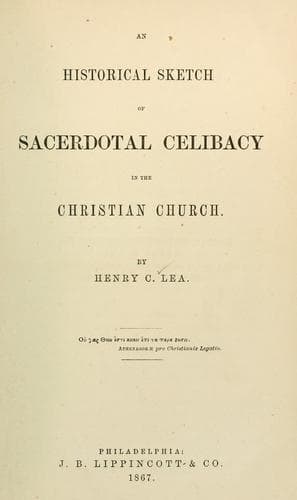
An Historical Sketch of Sacerdotal Celibacy in the Christian ChurchLea, Henry Charles
History
An Historical Sketch of Sacerdotal Celibacy in the Christian Church
Lea, Henry Charles
Catholic Church -- Clergy; Celibacy -- Catholic Church; Church history
The efforts of the reformers appear to have extended even to the
British churches of Wales, which had followed Saxon example in
abandoning celibacy. The Brut y Tywysogion relates that about the year
861 the priests were forbidden to marry without dispensation from the
pope; but they did not submit, and the disturbances thus provoked
rendered necessary the abandonment of the effort, so that sacerdotal
marriage continued unchecked.[422] We shall see hereafter that in the
Principality the custom remained in full vigor until the thirteenth
century was well advanced.
How thoroughly the work of Dunstan and Edgar was undone in England
is sufficiently indicated by the efforts made not long after, with
the consent of Ethelred, to introduce some feeble restraints upon
the prevailing immorality. About the year 1006 we find the chief
monastery of England, Christ Church at Canterbury, in full possession
of the secular clergy, whose irregularities were so flagrant that
even Ethelred was forced to expel them, and to fill their places with
monks.[423] What was the condition of discipline among the secular
priests may be guessed from the reformatory efforts of St. Ælfric, who
was Archbishop of Canterbury from 995 to 1006. In his series of canons
the first eight are devoted to inculcating the necessity of continence;
after quoting the Nicene canon, he feels it to be so much at variance
with the habits and customs of the age, that he actually deprecates the
surprise of his clergy at hearing a rule so novel and so oppugnant to
the received practice, “as though there was no danger in priests living
as married men;” he anticipates the arguments which they will bring
against him, and refutes them with more gravity than success.[424]
There is also extant, under the name of St. Ælfric, a pastoral epistle,
which is regarded as supposititious by some critics; but its passages
on this subject are too similar in spirit to the canons of Ælfric
to be reasonably rejected. They show how hopeless was the effort to
maintain the purity desired by the ecclesiastical authorities, and
that entreaties and exhortations were uttered merely from a sense of
duty, and with hardly an expectation of commanding attention. “This,
to you, priests, will seem grievous, because ye have your misdeeds in
custom, so that it seems to yourselves that ye have no sin in so living
in female intercourse as laymen; and say that Peter the Apostle had a
wife and children.... Beloved, we cannot now forcibly compel you to
chastity, but we admonish you, nevertheless, that ye observe chastity,
so as Christ’s ministers ought, in good reputation, to the pleasure of
God.”[425]
Public-domain text, read in full here on John Shaqi.
Reviews
Reviews
No reviews yet
Be the first to share your thoughts on this work.
Elsewhere in the archive
Join the Discussion
Join the discussion
Sign in to leave a comment or review.
Sign InorCreate an account