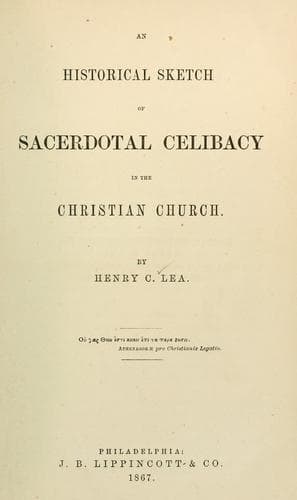
An Historical Sketch of Sacerdotal Celibacy in the Christian ChurchLea, Henry Charles
History
An Historical Sketch of Sacerdotal Celibacy in the Christian Church
Lea, Henry Charles
Catholic Church -- Clergy; Celibacy -- Catholic Church; Church history
That these well-meant homilies effected little in reforming the hearts
of so obdurate a generation becomes manifest by the proceedings of
the council of Enham, held by King Ethelred in 1009. The priests are
there entreated, by the obedience which they owe to God, to observe
the chastity which they know to be due. Yet so great was the laxity
prevailing that some are stated to have two or more wives, and many to
be in the habit of changing their spouses at pleasure, in violation of
all Christian law. The council was apparently, however, powerless to
repress these scandals by an adequate punishment, and contented itself
with promising to those who lived chastely the privileges and legal
status of nobles, while the vicious were vaguely threatened with the
loss of the grace of God and man.[426]
The injunctions of the council as regards the regular clergy, though
not particularly specific in their nature, show that even the monks
had not responded to the benefits conferred upon them by Edgar the
Pacific, nor fulfilled the expectations of the pious Dunstan. An
expression employed, indeed, leads the learned Spelman to suggest that
there possibly were two orders of monks, the one married and the other
unmarried; but this is probably without foundation.[427]
* * * * *
Such was the condition of the church when the increasing assaults of
the Northman finally culminated in overthrowing the house of Cerdic,
and placing the hated Dane upon the throne of England. Cnut’s long and
prosperous reign, and his earnest veneration for the church, as shown
by his pilgrimage to Rome, may perhaps have succeeded in removing some
of the grosser immoralities of the clergy, but that marriage was still
openly and unrestrainedly practised by those in orders is evident. The
ecclesiastical laws of Cnut exhort priests to chastity in precisely the
same words, and with the same promises as the canons of the council of
Enham, but do not allude to the habit of keeping a plurality of wives;
while, in the same chapter, a warning to the whole people against
unlawful concubinage would seem to indicate that clergy and laity were
bound by rules identical in strictness.[428]
Public-domain text, read in full here on John Shaqi.
Reviews
Reviews
No reviews yet
Be the first to share your thoughts on this work.
Elsewhere in the archive
Join the Discussion
Join the discussion
Sign in to leave a comment or review.
Sign InorCreate an account