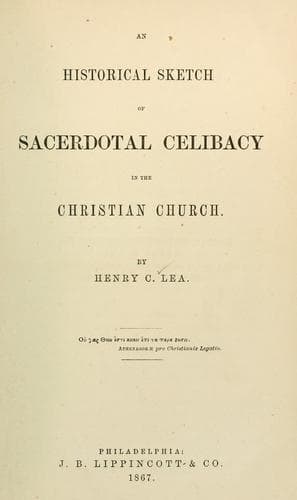
An Historical Sketch of Sacerdotal Celibacy in the Christian ChurchLea, Henry Charles
History
An Historical Sketch of Sacerdotal Celibacy in the Christian Church
Lea, Henry Charles
Catholic Church -- Clergy; Celibacy -- Catholic Church; Church history
The Saxon church thus was practically regardless of the rule of
celibacy when Edward the Confessor ascended the throne. The ascetic
piety of that prince and his Norman education alike led him to abhor
the sensual indulgences in which he found his subjects plunged, and
he attached himself almost exclusively to the horde of Norman monks
who flocked to his court from across the Channel. Their influence
was all-powerful, and though reasons of the highest state necessity
forced him to ally himself in marriage with Edith, daughter of the
puissant Duke Godwin, whom Edward hated with all the energy of his
feeble nature, it was not difficult for his artful ghostly counsellors
to persuade him that a vow of virginity, taken and kept amid the
seductions of a throne, would insure his glory in this world and his
salvation in the next. A minstrel historian describes at length the
engagement of perpetual chastity entered into between Edward and Edith
at their marriage, and though he mentions the popular derision to
which this exposed the royal monk at the hands of a gross and brutal
generation, he is firmly persuaded that the crown of martyrdom was
worthily won and worn—
Par veinere charnel desir,
Bein deit estre clamez martir.
Ne sai cunter en nul estoire
Rei ki feist si grant victoire,
Sa char, diable e mund venqui,
Ki sont troi fort enimi.[432]
How little the royal pair expected this example to be followed and
how relaxed were all the rules of monastic discipline is shown by an
anecdote of the period. The austere Gervinus, Abbot of St. Riquier in
Ponthieu was always welcomed by them when he visited England, and on
one occasion Queen Edith offered to kiss him. The Abbot’s rigidity
overcame his courtliness and he refused the royal salutation, to the
great indignation of the Queen, who ordered certain gifts which she
had set apart for him to be withdrawn. Edward, however, approved of
the action of the monk, and after Edith had been made to understand
his motives she not only joined in applauding him but demanded that a
similar rule should be made imperative on all the monks of England.[433]
It cannot be doubted that Edward made efforts to effect a reform among
his sensual and self-indulgent subjects, but his want of success is
developed in the description of the Saxon clergy at the time of the
Conquest. The Norman chroniclers speak of them as abandoned to sloth,
ignorance, and the lusts of the flesh; even monastic institutions were
matters rather of tradition than of actual existence, and the monks
themselves were hardly distinguishable by their mode of life from the
laity.[434] There doubtless may be some contemptuous exaggeration in
this, and yet one author of the period, who is wholly Saxon in his
feelings, does not hesitate to attribute the ruin of the Saxon monarchy
and the devastation of the kingdom to the just wrath of God, provoked
by the vices of the clergy.[435]
* * * * *
Public-domain text, read in full here on John Shaqi.
Reviews
Reviews
No reviews yet
Be the first to share your thoughts on this work.
Elsewhere in the archive
Join the Discussion
Join the discussion
Sign in to leave a comment or review.
Sign InorCreate an account