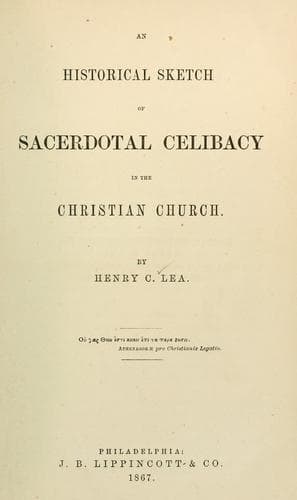
An Historical Sketch of Sacerdotal Celibacy in the Christian ChurchLea, Henry Charles
History
An Historical Sketch of Sacerdotal Celibacy in the Christian Church
Lea, Henry Charles
Catholic Church -- Clergy; Celibacy -- Catholic Church; Church history
The rule of the Normans removed England from her isolation. Brought
into the commonwealth of Christendom and under the active supremacy
of the Holy See, her history henceforth becomes more closely
connected with the general ecclesiastical movement which received its
irresistible impulsion about this period. That movement it is now our
business to examine.
XII.
PETER DAMIANI.
In a previous section I have shown the laxity prevailing throughout
Continental Europe at the commencement of the eleventh century. It
is not to be supposed, however, that even where this was tacitly
permitted, it was openly and unreservedly authorized. The perversity
of a sinful generation might render impossible the enforcement of
the ancient canons; they might even be forgotten by the worldly and
unthinking; but they were still the law of the church, and their
authority was still admitted by some ardent devotees who longed to
restore the purity of earlier ages. Burckhardt, who was Bishop of Worms
from the year 1000 to 1025, in his voluminous collection of canons,
gives a fair selection from the councils and decretals prohibiting all
female intercourse to the clergy.[436] Benedict VIII. and the Emperor
St. Henry II.—whose admiration of virginity was evinced by the personal
sacrifice to which reference has just been made—in 1022 endeavored in
the most solemn manner to reform the universal laxity. At the synod of
Pavia a series of canons was adopted pronouncing sentence of deposition
upon all priests, deacons, and subdeacons having wives or concubines,
and upon all bishops keeping women near them, while special stress
was laid upon the continued servitude of the children of all such
ecclesiastics as were serfs of the church.[437] These canons, signed
by the pope and attendant bishops, were laid before the emperor, who
indorsed them with his sanction, declared them to be municipal as
well as ecclesiastical law, promised that their observance should
be enforced by the civil magistrates, and thanked Benedict and his
prelates for their vigilance in seeking a remedy for the incontinence
of the clergy, the evils whereof swept like a storm over the face of
Christendom.[438]
Public-domain text, read in full here on John Shaqi.
Reviews
Reviews
No reviews yet
Be the first to share your thoughts on this work.
Elsewhere in the archive
Join the Discussion
Join the discussion
Sign in to leave a comment or review.
Sign InorCreate an account