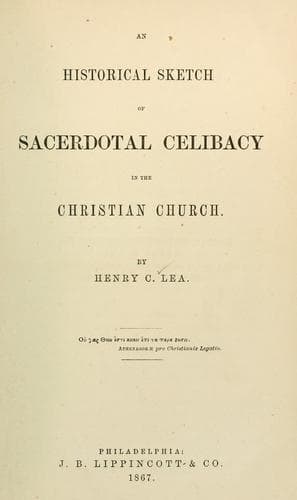
An Historical Sketch of Sacerdotal Celibacy in the Christian ChurchLea, Henry Charles
History
An Historical Sketch of Sacerdotal Celibacy in the Christian Church
Lea, Henry Charles
Catholic Church -- Clergy; Celibacy -- Catholic Church; Church history
Silently the church seemed to acquiesce in the violation of her canons,
until, at length, she appeared content if her ministers would satisfy
themselves with reputable marriage and avoid the grosser scandals. When
Ulric, Abbot of Tegernsee, about 1041, deplored the evil influence of
a priest who had two wives living, he seems to have felt that lawful
marriage might be tolerated, but that polygamy was of evil example in
a Christian pastor.[448] So when Albert the Magnificent, Archbishop of
Hamburg, was accustomed to exhort his clergy to continence and to shun
the pestiferous society of women, his worldly wisdom prompted him to
add that, if they were unequal to the effort, they should at least keep
unsullied the bonds of marriage and should live “si non caste, tamen
caute.”[449]
If irregularities such as these existed, they are not justly imputable
to the church itself. It can scarcely be a matter of wonder if the
clergy, in assimilating themselves to the laity as regards the
liberty of wedlock, should also have adopted the license which in
that lawless age rendered the marriage-tie a slender protection for
the weakness of woman. Though it was indissoluble according to the
teachings of religion, yet the church, which at that time was the
only protector of the feeble against the strong, had not acquired the
commanding authority which subsequently enabled it to enforce its
decrees everywhere and on all occasions. If, under a vigorous pope, the
sentence of excommunication had been able to frighten a superstitious
monarch like Robert the Pious, yet the pontiffs of the House of
Tusculum were not men to trouble themselves, or to be successful had
they made the attempt, to rectify the wrongs perpetrated in every
obscure baronial castle or petty hamlet in Europe. The isolation and
independence of the feudal system made every freeman, so to speak, the
arbiter of his own actions. The wife whose charms ceased to gratify
the senses of her husband, or whose temper threatened to disturb his
equanimity, stood little chance of retaining her position, if an
opportunity offered of replacing her to advantage, unless she was
fortunate in having kindred able to resent the wrong which the church
and the law were powerless to prevent or to punish.[450] If, then, the
clergy occasionally indulged in similar practices, the evil is not
attributable to the license of marriage which they had usurped. That
license had, at all events, borne some fruits of good, for, during
its existence, we hear somewhat less of the system of concubinage so
prevalent before and after this period, and there is no authentic
indication of the nameless horrors so suggestively intimated by the
restrictions on the residence of relatives enjoined in the frequent
canons promulgated at the close of the ninth century.
* * * * *
Public-domain text, read in full here on John Shaqi.
Reviews
Reviews
No reviews yet
Be the first to share your thoughts on this work.
Elsewhere in the archive
Join the Discussion
Join the discussion
Sign in to leave a comment or review.
Sign InorCreate an account