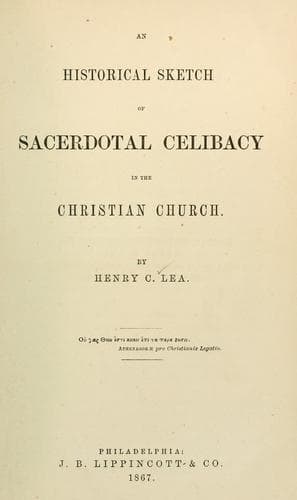
An Historical Sketch of Sacerdotal Celibacy in the Christian ChurchLea, Henry Charles
History
An Historical Sketch of Sacerdotal Celibacy in the Christian Church
Lea, Henry Charles
Catholic Church -- Clergy; Celibacy -- Catholic Church; Church history
Descending in the scale, we may instance the priest Marino, who, though
he lived openly with his wife, was a noted miracle-worker. Among
quaint wonders wrought by him it is recorded that water rendered holy
by his blessing, when sprinkled over the cornfields, had the power of
driving away all caterpillars and other noxious insects. His child,
Eleuchadio, was a most venerable man, who subsequently, as abbot of the
monastery of the Virgin at Fiano, won the esteem and respect of even
the stern Damiani himself.[444] In fact, the pious Desiderius, Abbot
of Monte Casino, better known as pope under the name of Victor III.,
declares that throughout Italy, under the pontificate of Benedict, all
orders, from bishops down, without shame or concealment, were publicly
married and lived with their wives as laymen, leaving their children
fully provided for in their wills; and what rendered the disgrace more
poignant was the fact that the scandal was greatest in Rome itself,
whence the light of religion and discipline had formerly illuminated
the Christian world.[445] Another contemporary writer asserts that this
laxity prevailed throughout the whole of Latin Christendom, sacerdotal
marriage being everywhere so common that it was no longer punished as
unlawful, and scarcely even reprehended.[446]
In becoming thus universal and tacitly permitted it was not
incompatible with the most fervent piety; and though it may be
an evidence of hierarchical disorganization, it can no longer be
considered as indicating of itself a lowered standard of morals in the
ministers of the church. This is forcibly illustrated in the case of
St. Procopius, selected by Duke Ulric of Bohemia as the first abbot
of the monastery of Zagow. He was regularly bred to the church under
the care of Bishop Quirillus, and was noted for the rectitude of his
deportment in the priesthood; yet we learn that he was married during
this period, when we are told that, on being disgusted with the hollow
vanities of the world, he abandoned wife and friends for the solitude
of a hermit’s cave. Here an accidental meeting with Duke Ulric, while
hunting, led to the foundation of Zagow and to the installation of
Procopius as its head.[447]
Public-domain text, read in full here on John Shaqi.
Reviews
Reviews
No reviews yet
Be the first to share your thoughts on this work.
Elsewhere in the archive
Join the Discussion
Join the discussion
Sign in to leave a comment or review.
Sign InorCreate an account