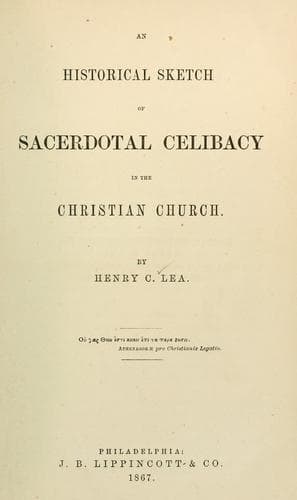
An Historical Sketch of Sacerdotal Celibacy in the Christian ChurchLea, Henry Charles
History
An Historical Sketch of Sacerdotal Celibacy in the Christian Church
Lea, Henry Charles
Catholic Church -- Clergy; Celibacy -- Catholic Church; Church history
St. Peter Damiani, who thus introduces himself to our notice, was one
of the remarkable men of the epoch. Born about the year 988 at Ravenna,
of a noble but decayed family, and the last of a numerous progeny,
he owed his life to a woman of the very class to the extirpation of
which he devoted all the energies of his prime. His mother, worn out in
the struggle with poverty, regarded his birth with aversion, refused
to suckle the infant saint, and neglected him until his forlorn and
emaciated condition awoke the compassion of a female retainer, the
wife of a priest, who remonstrated with the unfeeling parent until
she succeeded in arousing the sense of duty and restored to existence
the little sufferer, who was destined to bring unnumbered woes to all
who were of her condition.[456] His early years are said to have been
passed as a swineherd, till the opportunity for instruction offered
itself, which he eagerly embraced. Retiring at length from the world,
he joined the disciples of St. Romuald, who practised the strictest
monastic life, either as monks or hermits, at Avellana, near Agubio.
Immuring himself there in the desert, his austerities soon gained for
him the reputation of preëminent sanctity, and led to his election
as prior of the brotherhood. Gifted by nature with an intellect of
unusual strength, informed with all the learning of the day, his stern
asceticism, his dauntless spirit, and the uncompromising force of his
zeal brought him into notice and marked him as a fitting instrument in
the cause of reform. Occasionally, at the call of his superiors, he
left his beloved retreat to do battle with the hosts of evil, returning
with renewed zest to the charms of solitude, until, in 1057, Stephen
IX. forced him to accept the cardinalate and bishopric of Ostia—the
highest dignity in the Roman court. The duties of his episcopate,
however, conflicted with his monastic fervor, and after a few years he
rendered up the pastoral ring and staff and again returned to Avellana,
where he died in 1072, full of years and honors. His position and
authority can best be estimated from the terms employed by Alexander
II., who, when sending him on an important mission to France, described
him as next in influence to himself in the Roman church, and the chief
support of the Holy See.[457]
Public-domain text, read in full here on John Shaqi.
Reviews
Reviews
No reviews yet
Be the first to share your thoughts on this work.
Elsewhere in the archive
Join the Discussion
Join the discussion
Sign in to leave a comment or review.
Sign InorCreate an account