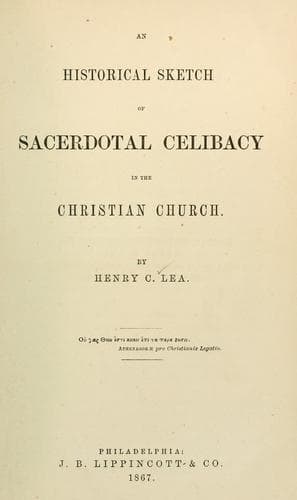
An Historical Sketch of Sacerdotal Celibacy in the Christian ChurchLea, Henry Charles
History
An Historical Sketch of Sacerdotal Celibacy in the Christian Church
Lea, Henry Charles
Catholic Church -- Clergy; Celibacy -- Catholic Church; Church history
With a nature ardent and combative, worked up to the highest pitch of
ascetic intolerance by the introspective musings of his cell, it may
readily be conceived that the corruptions of the church filled him
with warm indignation and fierce desire to restore it to its pristine
purity. To this holy cause he devoted the last half of his life, and
was always ready, with tongue and pen, at the sacrifice of his dearly
prized solitude, to further the great movement on which he felt that
the future of Christianity depended. The brief hopes excited by the
promises of Clement and Henry were speedily quenched by the untimely
death of the German pontiff, and the most sanguine might well despair
at seeing the odious Benedict IX. reinstated as pope. But the emperor
was in earnest, and listened willingly to the cry of those who besought
him not to leave his good work unfinished. Nine brief months saw
Benedict again a wanderer, and another German prelate installed in his
place. Poppo of Brixen, however, enjoyed his new dignity, as Damasus
II., but twenty-one days, when he fell a martyr to the cause, perishing
miserably, either through the insalubrious heats of a Roman summer,
or the hidden vindictiveness of Italian party rage. It required some
courage to accept the honorable but fatal post, and six months elapsed
ere a worthy candidate could be found. Henry’s choice this time fell
upon Bruno of Toul, a prelate to whom admiring biographers ascribe
every virtue and every qualification. As Leo IX. he ascended the
pontifical throne in February, 1049, and he soon gave ample evidence
of the sincerity with which he intended to carry out the views of the
puritans whom he represented.
It was significant that he took with him to Rome the monk Hildebrand,
lately released from the service of his master Gregory VI., who had
died in his German exile, restored by a miracle at his death to the
honors of which he had been adjudged unworthy while living.[458] Still
more significant was the fact that Leo entered Rome, not as pope, but
as a barefooted pilgrim, and that he required the empty formality of
an election within the city, as though the nomination of the emperor
had given him no claim to his high office. Whether this was the result
of a voice from heaven, as related by the papal historians,[459] or
whether it was done at the suggestion of the high-churchman Hildebrand,
it showed that the new pontiff magnified his office, and felt that the
line of distinction between the clerk and the layman was to be sharply
drawn and vigorously defended.
Public-domain text, read in full here on John Shaqi.
Reviews
Reviews
No reviews yet
Be the first to share your thoughts on this work.
Elsewhere in the archive
Join the Discussion
Join the discussion
Sign in to leave a comment or review.
Sign InorCreate an account