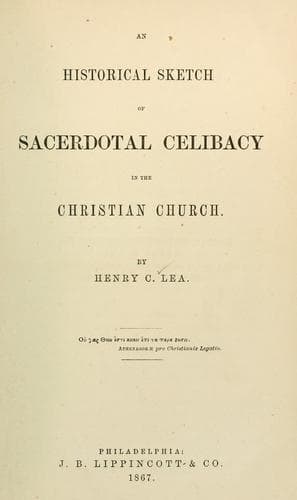
An Historical Sketch of Sacerdotal Celibacy in the Christian ChurchLea, Henry Charles
History
An Historical Sketch of Sacerdotal Celibacy in the Christian Church
Lea, Henry Charles
Catholic Church -- Clergy; Celibacy -- Catholic Church; Church history
His death in July, 1057, was followed after but a few days’ interval
by the election of Frederic, Duke of Lorraine—the empire having passed
in 1056 from the able hands of Henry III. to the feeble regency of his
empress, Agnes, as guardian of the unfortunate infant Henry IV.—thus
releasing the Roman clergy from the degrading dictation of a Teutonic
potentate. That Frederic should have abandoned the temptations and
ambitions of his lofty station to embrace the austerities of monastic
life in the abbey of Monte Casino, is a sufficient voucher that he
would not draw back from the work thus far hopelessly undertaken by his
predecessors. Notwithstanding the severity of the canons promulgated
during the previous decade, and the incessant attempts to enforce
them, Rome was still full of married priests, and the battle had to be
recommenced, as though nothing had yet been done. Immediately on his
installation, as Stephen IX., he addressed himself unshrinkingly to the
task. For four months, during the most unhealthy season, he remained
in Rome, calling synod after synod, and laboring with both clergy and
people to put an end to such unholy unions,[472] and he summarily
expelled from the church all who had been guilty of incontinence since
the prohibitions issued in the time of Leo.[473] One case is related
of a contumacious priest whose sudden death gave him the opportunity
of striking terror into the hearts of the reckless, for the mutilated
funeral rites which deprived the hardened sinner of the consolation of
a Christian burial it was hoped would prove an effectual warning to
his fellows.[474] Feeling the necessity of support in these thankless
labors, he forced Damiani to leave the retirement of the cloistered
shades of Avellana, and to bear, as Bishop of Ostia, his share of the
burden in the contest which he had done so much to provoke—but it was
all in vain.
Public-domain text, read in full here on John Shaqi.
Reviews
Reviews
No reviews yet
Be the first to share your thoughts on this work.
Elsewhere in the archive
Join the Discussion
Join the discussion
Sign in to leave a comment or review.
Sign InorCreate an account