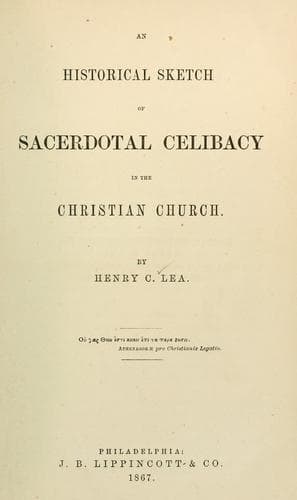
An Historical Sketch of Sacerdotal Celibacy in the Christian ChurchLea, Henry Charles
History
An Historical Sketch of Sacerdotal Celibacy in the Christian Church
Lea, Henry Charles
Catholic Church -- Clergy; Celibacy -- Catholic Church; Church history
It is not easy to repress a smile on seeing Leo, who had been so
utterly unable to enforce the canons of the Latin church at home,
seriously undertaking to procure their adoption in Constantinople.
From his prison, in January, 1054, he sent Cardinal Humbert of Silva
Candida on a mission to convert the Greek church. There is extant a
controversy between the legate and Nicetas Pectoratus, a learned Greek
abbot, on the various points in dispute. I cannot profess to decide
which of the antagonists had the advantage on the recondite questions
of the use of unleavened bread, the Sabbath fasts, the calculation
of Easter, &c., but the contrast between the urbanity of the Greek
and the coarse vituperation of the Latin is strikingly suggestive as
a tacit confession of defeat on the part of the latter. In view of
the frightful immorality of the Italian clergy, there is something
peculiarly ludicrous in the mingled anger, contempt, and abhorrence
with which Humbert alludes to the marriage of the Greek clergy, which,
as he declares, renders their church the synagogue of Satan and the
brothel of Balaam and Jezebel, with other equally courteous and
convincing arguments. Humbert attributes priestly marriage altogether
to the heresy of the Nicolites, and lays down the law on the subject
as inexorably as though it were at the time observed in his own
church.[470]
After an interval of about a year, the line of German pontiffs was
continued in the person of Gebhardt, Bishop of Eichstedt (Victor II.),
whose appointment by the emperor was owing in no small degree to the
influence of Hildebrand—an influence which was daily making itself more
felt. Installed in the pontifical seat by Godfrey, Duke of Tuscany,
his efforts to continue the reformation commenced by his predecessors
aroused a stubborn resistance. There may be no foundation for the
legend of his being saved by a miracle from a sacramental cup poisoned
by a vengeful subdeacon, nor for the rumors that his early death was
hastened by the recalcitrant clergy who sought to escape the severity
of his discipline. There is some probability in the stories, however,
for, during his short pontificate, interrupted by a lengthened stay in
Germany and the perpetual vicissitudes of the Neapolitan troubles, he
yet found time to hold a synod at Florence, where he degraded numerous
prelates for simony and licentiousness; but, whether true or false, the
existence of the reports attests at once the sincerity of his zeal and
the difficulties of the task.[471]
Public-domain text, read in full here on John Shaqi.
Reviews
Reviews
No reviews yet
Be the first to share your thoughts on this work.
Elsewhere in the archive
Join the Discussion
Join the discussion
Sign in to leave a comment or review.
Sign InorCreate an account