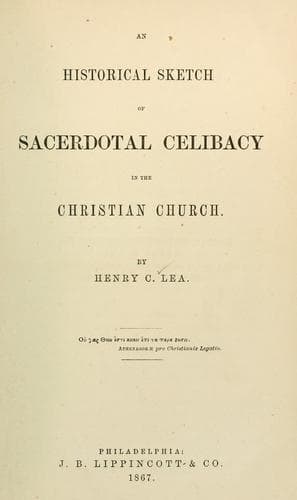
An Historical Sketch of Sacerdotal Celibacy in the Christian ChurchLea, Henry Charles
History
An Historical Sketch of Sacerdotal Celibacy in the Christian Church
Lea, Henry Charles
Catholic Church -- Clergy; Celibacy -- Catholic Church; Church history
The Janizaries of the Porte were Christian children, recruited by
the most degrading tribute which tyrannical ingenuity has invented.
Torn from their homes in infancy, every tie severed that bound them
to the world around them; the past a blank, the future dependent
solely upon the master above them; existence limited to the circle of
their comrades, among whom they could rise, but whom they could never
leave; such was the corps which bore down the bravest of the Christian
chivalry and carried the standard of the Prophet in triumph to the
walls of Vienna. Mastering at length their master, they wrung from
him the privilege of marriage; and the class in becoming hereditary,
with human hopes and fears disconnected with the one idea of their
service, no longer presented the same invincible phalanx, and at last
became terrible only to the effeminate denizens of the seraglio. The
example is instructive, and it affords grounds for the assumption
that the canon which bound all the active ministers of the church to
perpetual celibacy, and thus created an impassable barrier between them
and the outer world, was one of the efficient instruments in creating
and consolidating both the temporal and spiritual power of the Roman
hierarchy.
I.
ASCETICISM.
The most striking contrast between the Mosaic Dispensation and the Law
of Christ is the materialism of the one, and the pure spiritualism
of the other. The Hebrew prophet threatens worldly punishments, and
promises fleshly rewards: the Son of Man teaches us to contemn the
treasures of this life, and directs all our fears and aspirations
towards eternity. The exaggeration of these teachings by the zeal of
fervent disciples led to the ascetic efforts to subjugate nature,
which present so curious a feature in religious history, and of which
those concerning the relations of the sexes form the subject of our
consideration.
Public-domain text, read in full here on John Shaqi.
Reviews
Reviews
No reviews yet
Be the first to share your thoughts on this work.
Join the Discussion
Join the discussion
Sign in to leave a comment or review.
Sign InorCreate an account