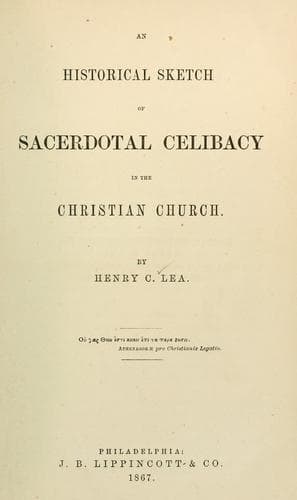
An Historical Sketch of Sacerdotal Celibacy in the Christian ChurchLea, Henry Charles
History
An Historical Sketch of Sacerdotal Celibacy in the Christian Church
Lea, Henry Charles
Catholic Church -- Clergy; Celibacy -- Catholic Church; Church history
The factions of the day had alienated a powerful portion of the Roman
barons from the papal party as represented by Hildebrand. They at
once united with the Lombard clergy in addressing a deputation to the
young Henry IV., who was still under the tutelage of his mother Agnes,
offering him a golden crown and the title of Patrician. The empire was
not indisposed to vindicate its old prerogatives, recently annulled by
the initial act of Nicholas limiting the right of papal election to the
Roman clergy. The overtures were therefore welcomed, and while Anselmo,
Bishop of Lucca, was chosen in Rome, October 1st, 1061, assuming the
name of Alexander II., on the 28th of the same month a rival election
took place in Germany, by which Cadalus, Bishop of Parma, was invested
with the perilous dignity of Antipope, and divided the allegiance
of Christendom under the title of Honorius II. At least two Italian
bishops lent their suffrages to these proceedings—those of Vercelli
and Piacenza—as representatives of the Lombard interest; and, if the
testimony of Damiani is to be believed, they were men whose dissolute
lives fitly represented the license which the reformers asserted to be
the principal object of the schismatics.[485]
The married or concubinary clergy were now no longer merely isolated
criminals, to be punished more or less severely for infractions
of discipline. They were a united body, who boldly proclaimed the
correctness of their course, and defended themselves by argument as
well as by political intrigues and military operations. They thus
became offenders of a far deeper dye, for the principles of the church
led irrevocably to the conclusion, paradoxical as it may seem, that
he who was guilty of immorality, knowing it to be wrong, was far
less criminal than he who married, believing it to be right.[486]
What before had been a transgression, to be redeemed by penance and
repentance, became heresy—an awful word in those fierce times. The
odious name of Nicolites was speedily fastened on the schismatics,
and the Apocalyptic denunciations of St. John were universally held
applicable to them. According to Damiani, they supported Cadalus in
the expectation that his success would lead to a modification in the
discipline of the church, by which the license to marry would be
accorded to all ecclesiastics.[487]
Public-domain text, read in full here on John Shaqi.
Reviews
Reviews
No reviews yet
Be the first to share your thoughts on this work.
Elsewhere in the archive
Join the Discussion
Join the discussion
Sign in to leave a comment or review.
Sign InorCreate an account