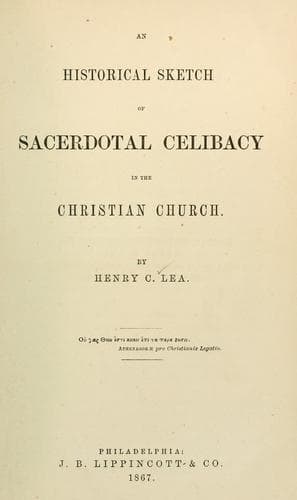
An Historical Sketch of Sacerdotal Celibacy in the Christian ChurchLea, Henry Charles
History
An Historical Sketch of Sacerdotal Celibacy in the Christian Church
Lea, Henry Charles
Catholic Church -- Clergy; Celibacy -- Catholic Church; Church history
That support was efficient, and it was shortly needed. A revolution
suddenly occurred in the politics of Germany. Some dissatisfied nobles
and prelates conspired to obtain power by overthrowing the regency of
the dowager Empress Agnes. A stroke of daring treachery put them in
possession of the person of the boy-king, and the arch-conspirator
Hanno of Cologne earned his canonization by reversing at once the
policy of the previous administration. In a solemn council held
at Osber in 1062, the pretensions of Cadalus were repudiated, and
Alexander II. was recognized as pope. Still Cadalus did not despair,
but with the aid of the Lombard clergy he raised forces and marched on
Rome, relying on his adherents within the walls. They admitted him into
the Leonine city, where he threw himself into the impregnable castle
of San Angelo. Immediately besieged by the Romans, he resolutely held
out for two years, in spite of incredible privations, but at length
he sought safety in flight with but a single follower. Meanwhile his
party, as a political body, had become broken up, and though Henry,
Archbishop of Ravenna, still adhered to him, he was powerless to
maintain his claims. Finally, in 1067, Alexander held a council
at Mantua, cleared his election of imputed irregularity, and was
universally recognized.
During this period, the “Nicolitan” clergy by no means abandoned their
tenets. In 1063, as soon as he could feel reasonably assured of his
eventual success, Alexander assembled more than a hundred bishops in
council at Rome, where he emphatically repeated the canon promulgated
in 1059 by Nicholas II., which was not only a proclamation of his
fidelity to the cause of reform, but an admission that the legislation
of his predecessor had thus far proved fruitless. Damiani, also,
labored unceasingly with argument and exhortation, but the vehemence
of his declamation only shows how widely extended and how powerful the
heresy still was. We shall see hereafter that on a mission to Milan,
to reduce the married clergy to obedience, he barely escaped with his
life; and on another to Lodi, with the same object, the schismatics,
after exhausting argument, in support of priestly marriage, threatened
him with arms in their hands, and again his saintly dignity came near
being enhanced by the honors of martyrdom.[488] Even the restriction
upon second marriages was occasionally lost sight of, and such most
irregular unions were celebrated with all the ceremony and rejoicings
that were customary among laymen in their public nuptials.[489] Yet,
notwithstanding the pious fervor which habitually stigmatized the wives
as harlots and the husbands as unbridled adulterers, Damiani himself
allows us to see that the marriage relation was preserved with thorough
fidelity on the part of the women, and was compatible with learning,
decency, and strict attention to religious duty by the men. Urging the
wives to quit their husbands, he finds it necessary to combat their
Public-domain text, read in full here on John Shaqi.
Reviews
Reviews
No reviews yet
Be the first to share your thoughts on this work.
Elsewhere in the archive
Join the Discussion
Join the discussion
Sign in to leave a comment or review.
Sign InorCreate an account