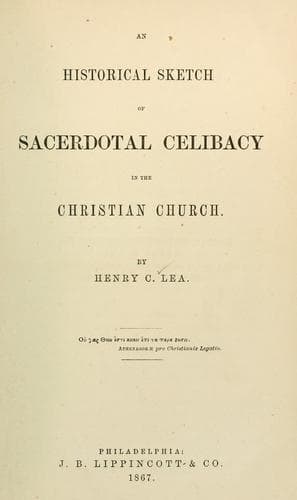
An Historical Sketch of Sacerdotal Celibacy in the Christian ChurchLea, Henry Charles
History
An Historical Sketch of Sacerdotal Celibacy in the Christian Church
Lea, Henry Charles
Catholic Church -- Clergy; Celibacy -- Catholic Church; Church history
scruples at breaking what was to them a solemn engagement, fortified
with all legal provisions and religious rites, but which he pronounces
a frivolous and meaningless ceremony.[490] So, in deploring the
habitual practice of marriage among the Piedmontese clergy, he regards
it as the only blot upon men who otherwise appeared to him as a chorus
of angels, and as shining lights in the church.[491]
Such considerations as these, however, had no influence in diminishing
Damiani’s zeal. To Cunibert, Bishop of Turin, whose spiritual flock he
thus so much admired, he addressed, about 1065, an epistle reproaching
him with his criminal laxity in permitting such transgressions in his
diocese, and urging him strenuously to undertake the reform which was
so necessary to the purity of the church.[492] Cunibert apparently
did not respond to the exhortation, for Damiani proceeded to appeal
to the temporal sovereign of Savoy and Piedmont, Adelaide, widow of
Humbert-aux-Blanches-Mains, who was then regent. In an elaborate
epistle he urges her to attack the wives, while her bishops shall
coerce the husbands; but if the latter neglect that duty, he invites
her to interpose with the secular power, and thus avert from her house
and her country the Divine wrath which must else overtake them.[493]
That so strict a churchman as Damiani should not only tolerate but
advise the exercise of temporal authority over ecclesiastics, and this,
too, in a matter purely ecclesiastical, shows how completely the one
idea had become dominant in his mind, since he was willing to sacrifice
to it the privileges and immunities for which the church had been
struggling, by fair means and foul, for six centuries. It would appear,
moreover, that this was not the first time that potentates had been
allowed, or had assumed, to exercise power in the matter, for Damiani
cautions the Countess Adelaide not to follow the example of some
evil-minded magnates and make the pretence of reformation an excuse for
spoiling the church.[494]
The zeal of the indefatigable Damiani continued to be as unconquerable
as the stubbornness of his adversaries, and some two years later we
find him again at work. The date of 1067 is generally attributed to a
letter which he addressed to Peter, Cardinal Archpriest of the Lateran,
stimulating him to renewed exertions in extirpating this foul disgrace
to the church, and arguing at great length in reply to the reasons and
excuses with which the clerical Benedicks continued to defend their
vile heresy.[495]
Public-domain text, read in full here on John Shaqi.
Reviews
Reviews
No reviews yet
Be the first to share your thoughts on this work.
Elsewhere in the archive
Join the Discussion
Join the discussion
Sign in to leave a comment or review.
Sign InorCreate an account