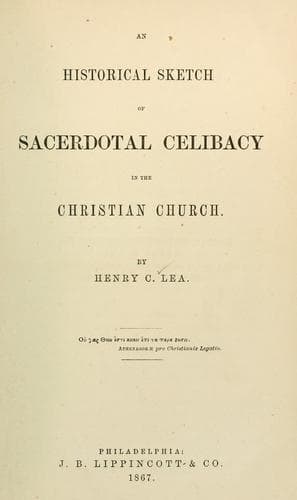
An Historical Sketch of Sacerdotal Celibacy in the Christian ChurchLea, Henry Charles
History
An Historical Sketch of Sacerdotal Celibacy in the Christian Church
Lea, Henry Charles
Catholic Church -- Clergy; Celibacy -- Catholic Church; Church history
Notwithstanding all his learning and eloquence, the authority of
his name, the lustre of his example, and the tireless efforts of
his fiery energy, the cause to which he had devoted himself did not
advance. The later years of Alexander’s pontificate afford unmistakable
indications that the puritan party were becoming discouraged; that
they were disposed to abate some of their demands, and were ready to
make concessions to the refractory spirit which refused obedience
in both principle and practice. Thus, in 1068, a decretal addressed
to the authorities of Dalmatia merely threatens suspension until
satisfaction is made by those who marry in orders or who refuse to
abandon their wives.[496] A somewhat different position was taken
with the Venetians. An epistle to the Patriarch of Grado orders the
deprivation of those who live in open and undisguised concubinage,
but significantly confines its penalties to notorious infractions
of the rule, and leaves to God the investigation of such as may be
prudently concealed.[497] This manifests a willingness to temporize
with offenders whose respect for papal authority would induce them to
abstain from defiant disobedience—a pusillanimous tempting of hypocrisy
to which the bolder Hildebrand could never have given his consent. A
principle of great importance, moreover, was abandoned when, in 1070,
Alexander assented to the consecration of the bishop-elect of Le Mans,
who was the son of a priest;[498] and when he stated that this was not
a precedent for the future, but merely a concession to the evil of the
times, his laxity was the more impressive, since he thus admitted his
violation of the canons. He subsequently even enlarged this special
permission into a general rule, with merely the saving clause that the
proposed incumbent should be more worthy than his competitors.[499]
Alexander, moreover, maintained in force the ancient rule that no
married man could assume monastic vows unless his wife gave her free
consent, and entered a convent at the same time.[500] We shall see
that in little more than half a century the progress of sacerdotalism
rendered the sacrament of marriage powerless in comparison with the
vows of religion.
Alexander clearly had not in him the stuff of which persecutors and
reformers are made, as, indeed, his merciful liberality in extending
over the Jews throughout Europe the protection of the Holy See
would sufficiently demonstrate. At length he, too, was released from
earthly cares, and on the day after his decease, on April 22, 1073,
his place was filled by the man who of all others was the most perfect
impersonation of the aggressive churchmanship of the age.
Public-domain text, read in full here on John Shaqi.
Reviews
Reviews
No reviews yet
Be the first to share your thoughts on this work.
Elsewhere in the archive
Join the Discussion
Join the discussion
Sign in to leave a comment or review.
Sign InorCreate an account