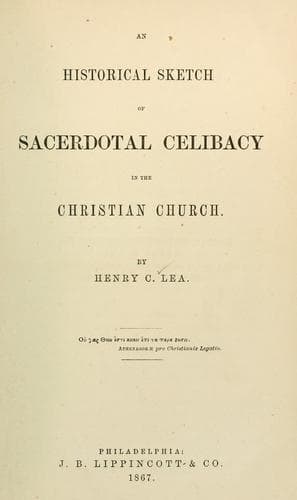
An Historical Sketch of Sacerdotal Celibacy in the Christian ChurchLea, Henry Charles
History
An Historical Sketch of Sacerdotal Celibacy in the Christian Church
Lea, Henry Charles
Catholic Church -- Clergy; Celibacy -- Catholic Church; Church history
Before proceeding, however, to sketch the stormy pontificate of
Hildebrand in its relation to our subject, I must pause to relate the
episode of the Milanese clergy. The struggle in that city to enforce
the ascetic principles of the reformers gives so perfect an inside view
of the reformation itself, and its various stages have been handed down
to us with so much minuteness by contemporary writers, that it deserves
to be treated by itself as a disconnected whole.
XIII.
MILAN.
In the primitive ages of the church, Milan was at the head of the
Northern Vicariate of Italy, as Rome was of the Southern. When the
preponderance of the latter city became established, the glory of
St. Ambrose shed a lustre over his capital which the true Milanese
fondly regarded as rivalling that of St. Peter and the superiority of
Rome was grudgingly admitted. In the eleventh century, Milan is found
occupying the chief place among the Lombard cities, virtually governed
by its archbishop, whose temporal as well as spiritual power rendered
his position one of great influence and importance. Yet even at that
early period, the republican spirit was already developed, and the city
was divided into factions, as the nobles and citizens struggled for
alternate supremacy.
Milan was moreover the headquarters of the hidden Manichæism which,
after surviving centuries of persecution in the East, was now secretly
invading Europe through Bulgaria, and had already attracted the
vigilant attention of the church in localities widely separated. Its
earliest open manifestation was in Toulouse, in 1018; at Orleans, in
1023, King Robert the Pious caused numerous sectaries to expiate their
heresy at the stake, where their unshrinking zeal excited general
wonder. At Cambrai and Liége similar measures of repression became
necessary in 1025; the Emperor Henry III. endeavored at Goslar, in
1052, to put an end to them with the gallows; and traces of them are
to be found at Agen about the year 1100; at Soissons in 1114; at
Toulouse in 1118; at Cologne in 1146; at Périgord in 1147; in England
in 1166, until we can trace their connection with the Albigenses, whose
misfortunes fill so black a page in the history of the thirteenth
century. Calling themselves Cathari, and stigmatized by true believers
under various opprobrious names, of which the commonest was Paterins,
their doctrines were those of the ancient Manichæans, their most
characteristic tenets being belief in the dualistic principle, and the
abhorrence of animal food and of marriage.[501] The prevalence of these
dogmas among the Milanese populace furnishes a probable explanation of
much that took place during the contest between Rome and the married
priests.
* * * * *
Public-domain text, read in full here on John Shaqi.
Reviews
Reviews
No reviews yet
Be the first to share your thoughts on this work.
Elsewhere in the archive
Join the Discussion
Join the discussion
Sign in to leave a comment or review.
Sign InorCreate an account