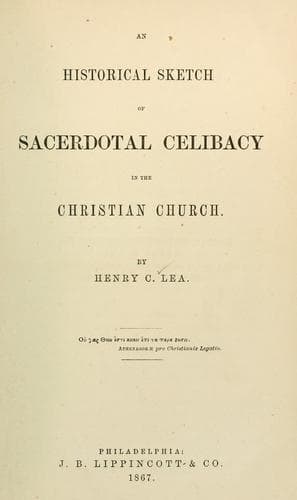
An Historical Sketch of Sacerdotal Celibacy in the Christian ChurchLea, Henry Charles
History
An Historical Sketch of Sacerdotal Celibacy in the Christian Church
Lea, Henry Charles
Catholic Church -- Clergy; Celibacy -- Catholic Church; Church history
Pataria, whence they soon became known as Paterins—a term which
for centuries continued to be of fearful import, as synonymous with
Manichæans.[506]
Matters could not long remain in this condition. During an altercation
in the church of San Celso, a hot-headed priest assaulted Arialdo,
whom Landolfo extricated from the crowd at considerable personal risk.
Thereupon the reformers called the people together in the theatre;
inflammatory addresses speedily wrought up the popular passions to
ungovernable fury; the priests were turned out of the churches,
their houses sacked, their persons maltreated, and they were finally
obliged to purchase a suspension of oppression by subscribing a paper
binding themselves to chastity. The nobles, far from being able to
protect the clergy, finding themselves also in danger, sought safety
in flight; while the rabble, having exhausted the support derivable
from intramural plunder, spread over the country and repeated in the
villages the devastations of priestly property which they had committed
in Milan.[507]
The suffering clergy applied for relief to the bishops of the province,
and finding none, at length appealed to Rome itself. Stephen IX.,
who then filled the papal chair, authorized the archbishop to hold a
synod for the purpose of restoring peace. It met, in the early part
of 1058, at Fontaneto, near Novara. The prelates were unanimous in
sustaining their clergy, and the reformers Landolfo and Arialdo were
excommunicated without a dissentient voice. They disregarded the
interdict, however, redoubled their efforts with the people, whom they
bound by a solemn oath to adhere to the sacred cause, and even forced
the priests to join in the compact. Arialdo then proceeded to Rome,
where he developed in full the objects of the movement, and pointed
out that it would not only result in restoring purity and discipline,
but might also be used to break down the dangerous independence of
the Ambrosian church and reduce it to the subjection which it owed
and refused to the Apostolic see. The arguments were convincing, the
excommunication was removed, and Arialdo returned to his work with zeal
more fiery than ever.[508]
Public-domain text, read in full here on John Shaqi.
Reviews
Reviews
No reviews yet
Be the first to share your thoughts on this work.
Elsewhere in the archive
Join the Discussion
Join the discussion
Sign in to leave a comment or review.
Sign InorCreate an account