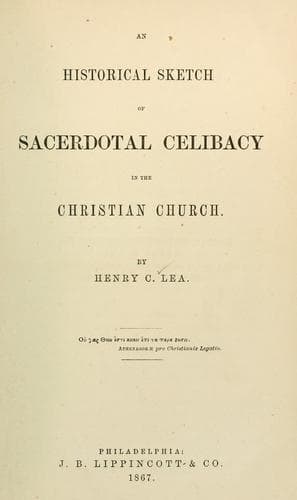
An Historical Sketch of Sacerdotal Celibacy in the Christian ChurchLea, Henry Charles
History
An Historical Sketch of Sacerdotal Celibacy in the Christian Church
Lea, Henry Charles
Catholic Church -- Clergy; Celibacy -- Catholic Church; Church history
Marriage, at this time, was a universal privilege of the Milanese
clergy. If we may believe the testimony of one who was almost a
contemporary, the candidate for holy orders was strictly examined
as to his learning and morals. These being satisfactory, he was, if
unmarried, asked if he had strength to remain so, and if he replied in
the negative, he could forthwith betroth himself and marry with the
ordinary legal and religious ceremonies. Second marriages were not
allowed, and the Levitical law as to the virginity of the bride was
strictly observed. Those who remained single were objects of suspicion,
while those who performed their sacred functions duly, and brought up
their families in the fear of God, were respected and obeyed by their
flocks as pastors should be, and were eligible to the episcopate.
Concubinage was regarded as a heinous offence, and those guilty of it
were debarred from all promotion[504]—in this reversing the estimate
placed upon the respective infractions of discipline by the Roman
church.
* * * * *
The see of Lucca consoled Anselmo di Badagio for the failure of his
aspirations towards the archiepiscopate, and the other disappointed
candidates for a while cherished their mortification in silence.
Landolfo and Arialdo were inclined to asceticism, and a visit which
Anselmo paid to Milan stimulated them to undertake a reform which
could not but prove a source of endless trouble to their successful
competitor Guido. Leaders of the people, and masters of the art of
inflaming popular passion, they caused assemblies to be held in which
they inveighed in the strongest terms against the irregularities of the
clergy, whose sacraments they stigmatized as the foulest corruption,
whose churches they denounced as dens of prostitution, and whose
property they assumed to be legitimate prey for the spoiler. Guido in
vain endeavored to repress the agitation thus produced, argued in favor
of the married clergy, and was sustained by the party of the nobles.
In a city like Milan, it was not difficult to excite a tumult. Besides
the influence of the perennial factions, ever eager to tear each
other’s throats, the populace were ready to yield to the eloquence of
the bold reformers. The Manichæan heresy had taken deep root among the
masses, who, afraid to declare their damnable doctrines openly, were
rejoiced in any way to undermine the authority of the priesthood, and
whose views were in accordance with those now broached on the subject
of marriage.[505] While these motives would urge forward the serious
portion of the citizens, the unthinking rabble would naturally be
prompt to embrace any cause which promised a prospect of disturbance
and plunder. Party lines were quickly drawn, and if the reformers were
able to revive a forgotten scandal by stigmatizing their opponents as
Nicolites, the party of the clergy and the nobles had their revenge.
The meetings of Landolfo and Arialdo were held in a spot called
Public-domain text, read in full here on John Shaqi.
Reviews
Reviews
No reviews yet
Be the first to share your thoughts on this work.
Elsewhere in the archive
Join the Discussion
Join the discussion
Sign in to leave a comment or review.
Sign InorCreate an account