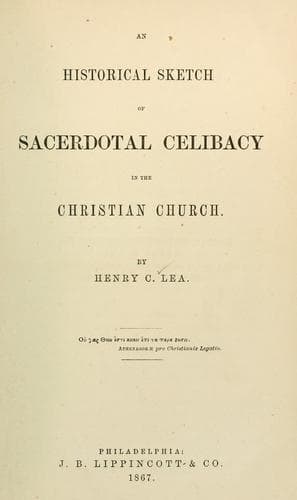
An Historical Sketch of Sacerdotal Celibacy in the Christian ChurchLea, Henry Charles
History
An Historical Sketch of Sacerdotal Celibacy in the Christian Church
Lea, Henry Charles
Catholic Church -- Clergy; Celibacy -- Catholic Church; Church history
Hildebrand was the son of a poor carpenter of Soano, and had been
trained in the ascetic monachism of Cluny. Gifted by nature with
rare sagacity, unbending will, and indomitable spirit, imbued with
the principles of the False Decretals, and firmly believing in the
wildest pretensions of ecclesiastical supremacy, he had conceived
a scheme of hierarchical autocracy, which he regarded not only as
the imprescriptible right of the church, but also as the perfection
of human institutions. To the realization of this ideal he devoted
his life with a fiery zeal and unshaken purpose that shrank from no
obstacles, and to it he was ready to sacrifice not only the men who
stood in his path, but also the immutable principles of truth and
justice. All considerations were as dross compared with the one object,
and his own well-being and life were ventured as recklessly as the
peace of the world.
Such a man could comprehend the full importance of the rule of
celibacy, not alone as essential to the ascetic purity of the church,
but as necessary to the theocratic structure which he proposed to
elevate on the ruins of kingdoms and empires. The priest must be a
man set apart from his fellows, consecrated to the one holy purpose,
reverenced by the world as a being superior to human passions and
frailties, devoted, soul and body, to the interests of the church, and
distracted by no temporal cares and anxieties foreign to the welfare
of the great corporation of which he was a member. We have seen the
strenuous efforts which, for a quarter of a century, successive
pontiffs had unceasingly made to accomplish this reform, and we have
also seen how fruitlessly those efforts were expended on the passive
or active resistance of the priesthood. When Hildebrand took the reins
into his vigorous grasp, the change at once became manifest, and the
zeal of his predecessors appears lukewarm by comparison. He had had
ample leisure to note how inefficient was the ordinary machinery to
accomplish the result, and he hesitated not to call to his assistance
external powers; to give to the secular princes authority over
ecclesiastics at which enthusiastic churchmen stood aghast, and to
risk apparently the most precious immunities of the church to secure
the result. The end proved his wisdom, for the power delegated to the
laity for a special object was readily recalled, after it had served
its purpose, and the rebellious clerks were subdued and rendered fit
instruments in the lapse of time for humiliating their temporary
masters. In one respect, however, Hildebrand’s policy proved a
blunder. The faithful readily submitted to the restoration of clerical
immunity, but the idea that ecclesiastics forfeited their privileges
by sin became a favorite one with almost all heretics, as we shall see
hereafter in the case of the Albigenses, Waldenses, Wickliffites, and
Hussites, costing the church many a desperate struggle.
Public-domain text, read in full here on John Shaqi.
Reviews
Reviews
No reviews yet
Be the first to share your thoughts on this work.
Elsewhere in the archive
Join the Discussion
Join the discussion
Sign in to leave a comment or review.
Sign InorCreate an account