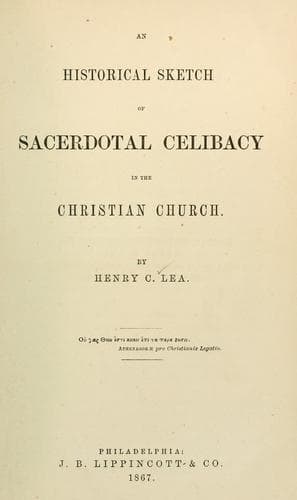
An Historical Sketch of Sacerdotal Celibacy in the Christian ChurchLea, Henry Charles
History
An Historical Sketch of Sacerdotal Celibacy in the Christian Church
Lea, Henry Charles
Catholic Church -- Clergy; Celibacy -- Catholic Church; Church history
To Gregory, as we must hereafter call him, was generally attributed, by
his immediate successors, the honor of introducing, or of enforcing,
the absolute chastity of the ministers of the altar. Some chroniclers
mention Alexander II. or Leo IX. as participating in the struggle, but
to his vigorous management its success was popularly conceded.[533]
He earned the tribute thoroughly, for during his whole pontificate
it seems to have been ever present to his thoughts, and whatever were
his preoccupations in his fearful struggle with the empire, on which
he risked the present and the future of the papacy, he always had
leisure to attend to the one subject in its minutest details and in the
remotest corner of Christendom.
Perhaps in this there may have been an unrecognized motive urging him
to action. Sprung from so humble an origin, he may have sympathized
with the democratic element, which rendered the church the only career
open to peasant and plebeian. He may have felt that this was a source
of hidden power, as binding the populations more closely to the
church, and as enabling it to press into service an unknown amount of
fresh and vigorous talent belonging to men who would owe everything
to the establishment which had raised them from nothingness, and who
would have no relationships to embarrass their devotion. All this
would be lost if, by legalizing marriage, the hereditary transmission
of benefices inevitably resulting should convert the church into a
separate caste of individual proprietors, having only general interests
in common, and lazily luxuriating on the proceeds of former popular
beneficence. To us, retrospectively philosophizing, it further appears
evident that if celibacy were an efficient agent in obtaining for
the church the immense temporal power and spiritual authority which
it enjoyed, that very power and that authority rendered celibacy a
necessity to the welfare of civilization. When even the humblest priest
came to be regarded as a superior being, holding the keys of heaven
in his hand, and by the machinery of confession, absolution, and
excommunication wielding incalculable influence over each member of
his flock, it was well for both parties that the ecclesiastic should
be free from the ties of family and the vulgar ambition of race. It
is easy to see how the churchmen could have selected matrimonial
alliances of the most politic and aggrandizing character; and as
possession of property and hereditary transmission of benefices would
have necessarily followed on the permission to marry, an ecclesiastical
caste, combining temporal and spiritual power in the most dangerous
excess, would have repeated in Europe the distinctions between the
Brahman and Sudra of India. The perpetual admission of self-made men
into the hierarchy, which distinguished the church even in times of
the most aristocratic feudalism, was for ages the only practical
recognition of the equality of man, and was one of the most powerful
Public-domain text, read in full here on John Shaqi.
Reviews
Reviews
No reviews yet
Be the first to share your thoughts on this work.
Elsewhere in the archive
Join the Discussion
Join the discussion
Sign in to leave a comment or review.
Sign InorCreate an account