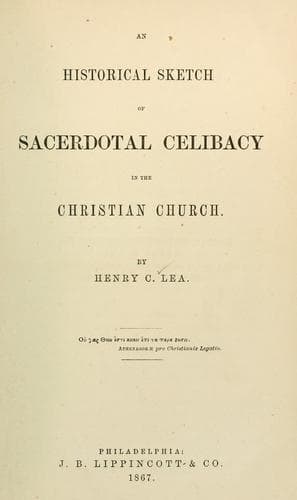
An Historical Sketch of Sacerdotal Celibacy in the Christian ChurchLea, Henry Charles
History
An Historical Sketch of Sacerdotal Celibacy in the Christian Church
Lea, Henry Charles
Catholic Church -- Clergy; Celibacy -- Catholic Church; Church history
To Otho, Gregory, in 1074, sent the canons of the synod inhibiting
marriage and simony, with orders to use every exertion to secure
the compliance of his clergy. Otho apparently did not manifest much
eagerness to undertake the unpopular task, and Gregory lost little
time in calling him to account. Before the year expired, we find the
pope addressing a second epistle to the bishop, angrily accusing him
of disobedience in permitting the ministration of married priests,
and summoning him to answer for his contumacy at a synod to be held
in Rome during the approaching Lent. Nor was this all, for at the
same time he wrote to the clergy and people of the diocese, informing
them of the disobedience of their bishop and of his summons to trial,
commanding them, in case of his persistent rebellion, to no longer
obey or reverence him as bishop, and formally releasing them from all
subjection to him. Otho doubtless considered it imprudent to show
himself at the synod of 1075; consequently in that of 1076 he was
excommunicated and deprived of his episcopal functions. During the
autumn of the same year, however, the legate Altmann of Passau restored
him to communion at Ulm, but without granting him the privilege of
officiating. Otho disregarded this restriction, and not only persisted
in exercising his functions, but openly favored and protected the
married clergy. For this Gregory absolved his flock from all obedience
to him, whereupon Otho abandoned the Catholic party and formally
joined the imperialists, who were then engaged in the effort to depose
Gregory. From some motives of policy, the pope granted the hardened
sinner three years for repentance, at the expiration of which, in 1080,
he sent Altmann to Constance to superintend the election of another
bishop. The new incumbent, however, proved incapable through bodily
infirmity; and, in 1084, Otto of Ostia was sent to Constance, and under
his auspices Gebhardt was elected bishop, and duly consecrated in
1085.[541] Evidently Gregory was not a man to abandon his purpose, and
those who opposed him could not count upon perpetual immunity.
Public-domain text, read in full here on John Shaqi.
Reviews
Reviews
No reviews yet
Be the first to share your thoughts on this work.
Elsewhere in the archive
Join the Discussion
Join the discussion
Sign in to leave a comment or review.
Sign InorCreate an account