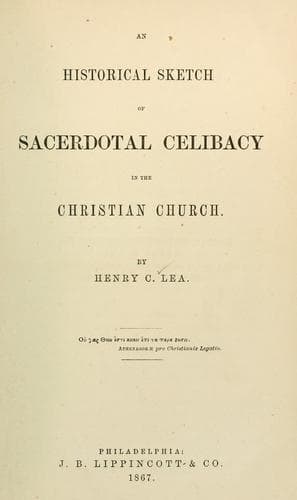
An Historical Sketch of Sacerdotal Celibacy in the Christian ChurchLea, Henry Charles
History
An Historical Sketch of Sacerdotal Celibacy in the Christian Church
Lea, Henry Charles
Catholic Church -- Clergy; Celibacy -- Catholic Church; Church history
St. Altmann of Passau was renowned for his piety and the strictness
of his religious observance. When the canon of 1074 reached him, he
assembled his clergy, read it to them, and adjured them to pay to it
the respect which was requisite. His eloquence was wasted; the clerks
openly refused obedience, and defended themselves by immemorial custom,
and by the fact that none of their predecessors had been called upon
to endure so severe and unnatural a regulation. Finding the occasion
unpropitious, the pious Altmann dissembled; he assured his clergy that
he was perfectly willing to indulge them if the papal mandate would
permit it, and with this he dismissed them. He allowed the matter
to lie in abeyance until the high feast of St. Stephen, the patron
saint of the church, which was always attended by the magnates of the
diocese. Then, without giving warning of his intentions, he suddenly
mounted the pulpit, read to the assembled clergy and laity the letters
of the pope, and threatened exemplary punishment for disobedience.
Though thus taken at advantage and by surprise, the clerks were not
disposed to submit. A terrible tumult at once arose, and the crafty
saint would have been torn to pieces had it not been for the strenuous
interference of the nobles, aided, as his biographer assures us, by the
assistance of God. The clergy continued their resistance, and when,
not long after, the empire and papacy became involved in internecine
strife, they sought the protection of Henry IV., who marched upon
Passau, and drove out St. Altmann and his faction. How unbending was
this opposition, and how successfully it was maintained, is manifest
from the fact that when St. Altmann at length returned to his diocese
as papal legate, about the year 1081, even Gregory felt it necessary
to use policy rather than force, and instructed him to yield to the
pressure of the evil times, and to reserve the strict enforcement of
the reform for a more fortunate period.[542] The political question had
thus, for the moment, overshadowed the religious one.
Public-domain text, read in full here on John Shaqi.
Reviews
Reviews
No reviews yet
Be the first to share your thoughts on this work.
Elsewhere in the archive
Join the Discussion
Join the discussion
Sign in to leave a comment or review.
Sign InorCreate an account