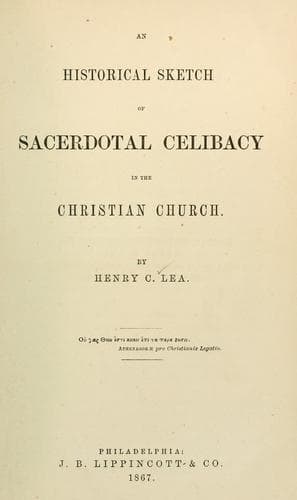
An Historical Sketch of Sacerdotal Celibacy in the Christian ChurchLea, Henry Charles
History
An Historical Sketch of Sacerdotal Celibacy in the Christian Church
Lea, Henry Charles
Catholic Church -- Clergy; Celibacy -- Catholic Church; Church history
These extraordinary measures called forth indignant denunciations
on the part of ecclesiastics, for these letters were circulars sent
to all the princes on whom he could depend, and he insured their
publicity by causing similar orders to be published in the churches
themselves. Thus Theodoric, Bishop of Verdun, who had inclined to
the side of Gregory and had secretly left the Assembly of Utrecht in
1076 to avoid countenancing by his presence the excommunication then
pronounced against the pope, in a letter to Gregory bitterly reproaches
his own folly in promulgating the decretal and in not foreseeing its
effect as destructive to the peace of the church, to the safety of the
clerical order, and as creating a disturbance which threatened even the
Christian faith.[547] So Henry, Bishop of Speyer, indignantly denounced
him as having destroyed the authority of the bishops and subjected the
church to the madness of the people;[548] and when the bishops, at the
Diet of Worms, threw off their allegiance to him, one of the reasons
alleged, in Henry’s letter to him, is the surrender which he had made
of the church to the laity.[549] Yet Gregory was not to be diverted
from his course, and he was at least successful in rousing the Teutonic
church from the attitude of passive resistance which threatened to
render his efforts futile. The princes of Germany, who were already
intriguing with Gregory for support in their perennial revolts against
their sovereign, were delighted to seize the opportunity of at once
obliging the pope, creating disturbance at home, and profiting by the
church property which they could manage to get into their hands by
ejecting the unfortunate married priests. They accordingly proceeded to
exercise, without delay and to the fullest extent, the unlimited power
so suddenly granted them over a class which had hitherto successfully
defied their jurisdiction; nor was it difficult to excite the people
to join in the persecution of those who had always held themselves as
superior beings, and who were now pronounced by the highest authority
in the church to be sinners of the worst description. The ignorant
populace were naturally captivated by the idea of the vicarious
mortification with which their own errors were to be redeemed by the
abstinence imposed upon their pastors, and they were not unreasonably
led to believe that they were themselves deeply wronged by the want
of purity in their ecclesiastics. Add to this the attraction which
persecution always possesses for the persecutor, and the license
of plunder so dear to a turbulent and barbarous age, and it is not
difficult to comprehend the motive power of the storm which burst over
the heads of the secular clergy, and which must have satisfied by its
severity the stern soul of Gregory himself.
Public-domain text, read in full here on John Shaqi.
Reviews
Reviews
No reviews yet
Be the first to share your thoughts on this work.
Elsewhere in the archive
Join the Discussion
Join the discussion
Sign in to leave a comment or review.
Sign InorCreate an account