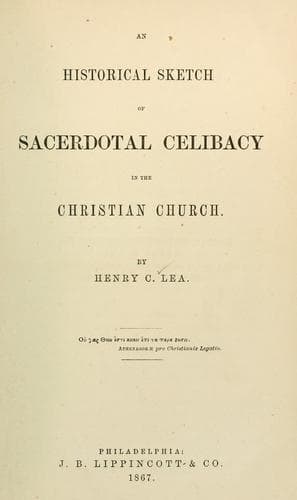
An Historical Sketch of Sacerdotal Celibacy in the Christian ChurchLea, Henry Charles
History
An Historical Sketch of Sacerdotal Celibacy in the Christian Church
Lea, Henry Charles
Catholic Church -- Clergy; Celibacy -- Catholic Church; Church history
A contemporary writer, whose name has been lost, but who is supposed
by Dom Martène to have been a priest of Trèves, gives us a very lively
picture of the horrors which ensued, and as he shows himself friendly
in principle to the reform attempted, his account may be received as
trustworthy. He describes what amounted almost to a dissolution of
society, slave betraying master and master slave; friend informing
against friend; snares and pitfalls spread before the feet of all;
faith and truth unknown. The peccant priests suffered terribly. Some,
reduced to utter poverty, and unable to bear the scorn and contempt
of those from whom they had been wont to receive honor and respect,
wandered off as homeless exiles; others, mutilated by the indecent
zeal of ardent puritans, were carried around to exhibit their shame
and misery; others, tortured in lingering death, bore to the tribunal
on high the testimony of blood-guiltiness against their persecutors;
while others, again, in spite of danger, secretly continued the
connections which exposed them to all these cruelties. In the midst
of these troubles, as might be expected, the offices of religion were
wholly neglected; the new-born babe received no holy baptism; the dying
penitent expired without the saving viaticum; the sinner could cleanse
his soul by no confession and absolution; and the devotee could no
longer be strengthened by the daily sacrifice of the mass.[550] Another
writer, of nearly the same date, relates with holy horror how the laity
shook off all the obedience which they owed to their pastors, and,
despising the sacraments prepared by them, trod the Eucharist under
foot and cast out the sacred wine, administered baptism with unlicensed
hands, and substituted for the holy chrism the filthy wax collected
from their own ears.[551]
When such was the fate of the pastors, it is easy to imagine the
misery inflicted on their unfortunate wives. A zealous admirer of
Gregory relates with pious gratulation, as indubitable evidence of
divine vengeance, how, maddened by their wrongs, some of them openly
committed suicide, while others were found dead in the beds which they
had sought in perfect health; and this being proof of their possession
by the devil, they were denied Christian sepulture. The case of Count
Manigold of Veringen affords a not uninstructive instance of the
frightful passions aroused by the relentless cruelty which thus branded
them as infamous, tore them from their families, and cast them adrift
upon a mocking world. The count had put in force the orders of Gregory
with strict severity throughout his estates in the Swabian Alps. One
miserable creature thus driven from her husband swore that the count
should undergo the same fate, and, in the blindness of her rage, she
poisoned the Countess of Veringen, whose widowed husband, overwhelmed
with grief, sought no second mate.[552]
Public-domain text, read in full here on John Shaqi.
Reviews
Reviews
No reviews yet
Be the first to share your thoughts on this work.
Elsewhere in the archive
Join the Discussion
Join the discussion
Sign in to leave a comment or review.
Sign InorCreate an account