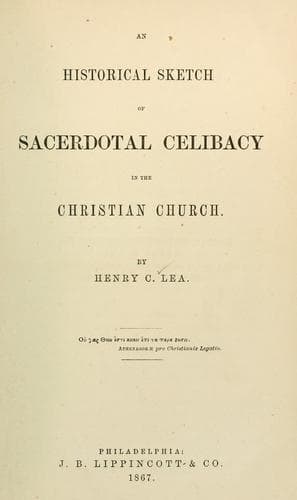
An Historical Sketch of Sacerdotal Celibacy in the Christian ChurchLea, Henry Charles
History
An Historical Sketch of Sacerdotal Celibacy in the Christian Church
Lea, Henry Charles
Catholic Church -- Clergy; Celibacy -- Catholic Church; Church history
The cause of asceticism, it is true, had gained many adherents among
the laity. Throughout Germany, husbands and wives separated from each
other in vast numbers, and devoted themselves to the service of the
church, without taking vows or assuming ecclesiastical garments; while
those who were unmarried renounced the pleasures of the world, and,
placing themselves under the direction of spiritual guides, abandoned
themselves entirely to religious duties. To such an extent did this
prevail, that the pope was applied to for his sanction, which he
eagerly granted, and the movement doubtless added strength to the party
of reform.[565] Yet but little had thus far been really gained in
purifying the church itself, notwithstanding the fearful ordeal through
which its ministers had passed.
As for Germany, the indomitable energy of Henry IV., unrepressed by
defeat and unchilled by misfortune, had at length achieved a virtual
triumph over his banded enemies. But four bishops of the Empire—those
of Wurzburg, Passau, Worms, and Constance—owed allegiance to Urban
II. All the other dioceses were filled by schismatics, who rendered
obedience to the anti-pope Clement. In 1089 the Catholic or papalist
princes offered to lay down their arms and do homage to Henry if he
would acknowledge Urban and make his peace with the true church. The
emperor, however, had a pope who suited him, and he entertained too
lively a recollection of the trials from which he was escaping to open
the door to a renewal of the papal pretensions, which he had at length
successfully defied, nor would he consent to stigmatize his faithful
prelates as schismatics.[566] He therefore pursued his own course, and
Guiberto of Ravenna enjoyed the honors of the popedom, checkered by
alternate vicissitudes of good and evil fortune, until removed by death
in the year 1100,[567] his sanctity attested by the numerous miracles
wrought at his tomb, which only needed the final success of the
imperialist cause to enrich the calendar with a St. Clement in place of
a St. Gregory and a St. Urban.[568]
Public-domain text, read in full here on John Shaqi.
Reviews
Reviews
No reviews yet
Be the first to share your thoughts on this work.
Elsewhere in the archive
Join the Discussion
Join the discussion
Sign in to leave a comment or review.
Sign InorCreate an account