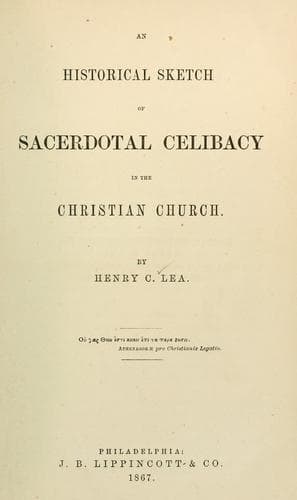
An Historical Sketch of Sacerdotal Celibacy in the Christian ChurchLea, Henry Charles
History
An Historical Sketch of Sacerdotal Celibacy in the Christian Church
Lea, Henry Charles
Catholic Church -- Clergy; Celibacy -- Catholic Church; Church history
to annul the reforms of Gregory, since in no other way could they be
carried into effect; but he was forced to coincide with Gregory as to
the principle which dictated those reforms. Notwithstanding all these
precautions, however, the papalists were not disposed to allow their
opponents to escape the responsibility of the alliance which brought
them so much strength by dividing the church, and no opportunity was
lost of stigmatizing them for the license which they protected. When
Guiberto and his cardinals were driven out of Rome in 1084 by Robert
Guiscard and his Normans, the flying prelates were ridiculed, not
for their cowardice, but for their shaven chins, and the wives and
concubines whom they publicly carried about with them.[562]
At length Henry and his partisans appear to have felt it necessary to
make some public declaration to relieve themselves from the odium of
supporting and favoring a practice which was popularly regarded as a
heresy and a scandal. When the papalists, under their King Hermann,
at the Easter of 1085 (April 20th), convened a general assembly of
their faction at Quedlinburg and again forbade all commerce with women
to those in orders,[563] the imperialists lost no time in putting
themselves on the same record with their rivals. Three weeks later
Henry gathered around him, at Mainz, all the princes and prelates who
professed allegiance to him, for the purpose of securing the succession
to his eldest son, Conrad, as King of Germany, and there, in that
solemn diet, marriage was formally prohibited to the priesthood.[564]
Gregory was then lying on his dying bed in the far off castle of
Salerno, and ere the news could reach him he was past the vanities of
earthly triumph. Could he have known, however, that the cause for which
he had risked the integrity and independence of the church had thus
received the support of its bitterest enemies, and that his unwavering
purpose had thus achieved the moral victory of forcing his adversaries
to range themselves under his banner, his spirit would have rejoiced,
and his confidence in the ultimate success of the great theocratic
system, for the maintenance of which he was thus expiring in exile,
would have softened the sorrows of a life which closed in the darkness
and doubt of defeat.
XV.
CENTRAL EUROPE.
Hildebrand had passed away, leaving to his successors the legacy of
inextinguishable hate and unattained ambition. Nor was the reform for
which he had labored as yet by any means secured in practice, even
though his opponents had been reduced to silence or had been forced
to render a formal adhesion to the canons which he had proclaimed so
boldly.
Public-domain text, read in full here on John Shaqi.
Reviews
Reviews
No reviews yet
Be the first to share your thoughts on this work.
Elsewhere in the archive
Join the Discussion
Join the discussion
Sign in to leave a comment or review.
Sign InorCreate an account