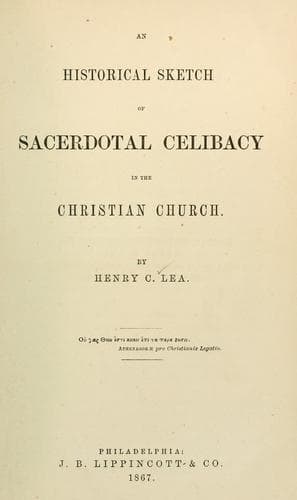
An Historical Sketch of Sacerdotal Celibacy in the Christian ChurchLea, Henry Charles
History
An Historical Sketch of Sacerdotal Celibacy in the Christian Church
Lea, Henry Charles
Catholic Church -- Clergy; Celibacy -- Catholic Church; Church history
Yet even in those regions of Germany which persevered in resisting
Henry and in recognizing Urban as pope, the persecution of twenty
years was still unsuccessful, and the people had apparently relapsed
into condoning the wickedness of their pastors. In an assembly held
at Constance in 1094, it was deemed necessary to impose a fine on all
who should be present at the services performed by priests who had
transgressed the canons.[572] When this was the case in the Catholic
provinces, it is easy to imagine that in the imperialist territories
the thunders of Gregory and Urban had long since been forgotten, and
that marrying and giving in marriage were practised with as little
scruple as ever. A fair illustration, indeed, of the amount of respect
paid to the rules of discipline is afforded by a discussion on the
choice of a successor to Cosmo Bishop of Prague, who died in 1098.
Duke Brecislas, in filling the vacancy with his chaplain Hermann,
endeavored to rebut the arguments of those who objected to the foreign
birth of the appointee by urging that fact as a recommendation, since,
as a stranger, he would not be pressed upon by a crowd of kindred nor
be burdened with the care of children, thus showing that the native
priesthood, as a general rule, were heads of families.[573] For this,
moreover, they could not plead ignorance, for a Bohemian penitential
of the period expressly prohibits priests from having companions whose
society could give rise to suspicion of any kind.[574]
* * * * *
At length the duel which, for more than thirty years, Henry had so
gallantly fought with the successors of St. Peter drew to a close. Ten
years of supremacy he had enjoyed in Germany, and he looked forward
to the peaceful decline of his unquiet life, when the treacherous
calm was suddenly disturbed. Papal intrigues in 1093 had caused the
parricidal revolt of his eldest born, the weak and vacillating Conrad,
whose early death had then extinguished the memory of his crime. That
unnatural rebellion had gained for Rome the North of Italy; and as
the emperor’s second son, Henry, grew to manhood, he, too, was marked
as a fit instrument to pierce his father’s heart, and to extend the
domination of the church by the foulest wrongs that man can perpetrate.
The startling revolution which in 1105 precipitated Henry from a throne
to a prison, from an absolute monarch to a captive embracing the knees
of his son and pleading for his wretched life, established forever the
supremacy of the papacy over Germany. The consequent enforcement of the
law of celibacy became only a question of time.
Public-domain text, read in full here on John Shaqi.
Reviews
Reviews
No reviews yet
Be the first to share your thoughts on this work.
Elsewhere in the archive
Join the Discussion
Join the discussion
Sign in to leave a comment or review.
Sign InorCreate an account